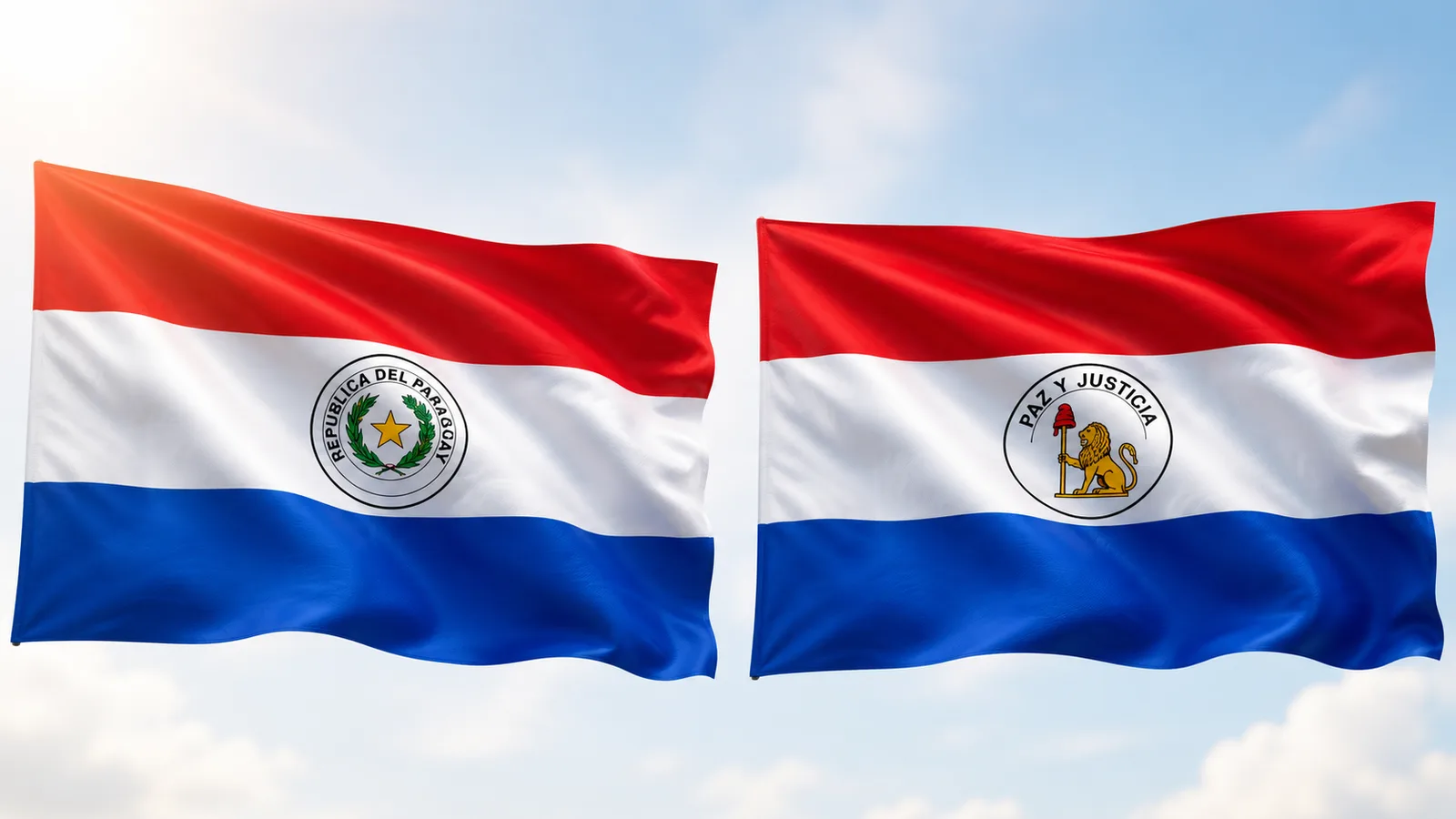
Most national flags look the same from either side, even when the image on the back is technically mirrored. Paraguay’s does not. In its complete official form, the red-white-blue tricolour carries one emblem on the obverse and another on the reverse. That makes it one of the very few national flags whose two faces are intentionally different.
On the front is the national coat of arms: a five-pointed star surrounded by palm and olive branches, with the words República del Paraguay. On the reverse is the Treasury seal: a lion beside a staff topped by a Phrygian cap, with the motto Paz y Justicia—Peace and Justice.
The difference is not a printing curiosity. The two emblems preserve decisions made while Paraguay was asserting its sovereignty and creating the visual language of a republic.
The tricolour came first
Red, white and blue appeared in Paraguay’s early post-independence flags in several arrangements. The horizontal tricolour associated with 15 August 1812 eventually became the enduring basis. On 25 November 1842, an extraordinary congress established the national flag and its emblems as part of a broader assertion of independence.
The context matters. Paraguay had declared independence in 1811, but recognition and relations with its neighbours were still contested. State symbols were not decorative extras. A flag, seal and official coat of arms said that the country had institutions, authority and a separate political identity.
The 1842 design placed the two shields in the centre of the white stripe, one on each face. Later rules refined proportions and artistic details, but the central idea survived: one flag, two official seals.
The obverse: republic and independence
The star on the national coat of arms is commonly known as the Star of May, linking the emblem with independence. The palm and olive branches form a wreath around it. Palm can signify honour or victory; olive is widely associated with peace. The inscription names the state directly.
This is the side most often reproduced as ‘the Paraguayan flag’ in international charts, emoji-style graphics and simplified illustrations. When a flag is manufactured correctly, however, turning it over should not reveal a reversed copy of the star emblem.
The reverse: peace, justice and vigilance
The Treasury seal is visually more narrative. A lion rests in front of a staff carrying a Phrygian cap, a republican symbol of liberty. The animal looks calm but capable of defending that liberty. Around it runs the motto Paz y Justicia.
The usual English name ‘Treasury seal’ can make the emblem sound like a logo for the modern finance ministry. Historically, Sello de Hacienda refers to an official state seal with roots in the young republic’s public authority and finances. Its presence on the flag elevates it beyond an office brand.
The two faces can be read together. The national arms identify the sovereign republic; the reverse joins liberty with the promise of peace and justice. They are not competing designs but two statements carried by the same state.
Is Paraguay the only country with a two-sided flag?
The popular claim that it is the world’s only one is too absolute. Official Paraguayan explanations generally describe it as one of three national flags with non-identical faces, mentioning Moldova and Saudi Arabia. The exact count can change with definitions: some flags show a mirrored emblem, some contain writing that must read correctly on both faces, and manufacturers may construct official and civil versions differently.
Paraguay remains exceptional for a clearer reason. Its two sides intentionally carry two distinct state emblems. In the Americas, it is routinely identified as unique in that respect.
Why many examples look wrong
Cheap or simplified flags often print the national coat of arms on both sides, allow ink to bleed through, omit the reverse seal, or mirror one emblem. Small digital icons usually show only the obverse. That is understandable at tiny scale but incomplete as an explanation of the official pavilion.
The legal distinction between a plain tricolour and the full Pabellón de la República also affects what appears in different settings. Paraguay’s state ceremonial law treats the pavilion, national seal and anthem as symbols of the republic and sets rules of respect and precedence for official acts.
Flag Day is observed on 14 August, immediately before the 15 August anniversary associated with Asunción and the historic tricolour. Schools and public institutions use the date to teach both faces, though the flag itself is a national symbol every day rather than only on the holiday.
How to read it
If the star, palm and olive are visible, you are looking at the obverse. If you see the lion, cap and Paz y Justicia, you are looking at the reverse. The horizontal colours do not change: red above, white in the centre and blue below.
The most interesting fact is not merely that Paraguay found a way to make flag production harder. The two-sided design is a compact constitutional story. A nineteenth-century republic used one face to name itself and the other to express the order it claimed to defend. More than 180 years later, both still travel together whenever the complete flag is raised.