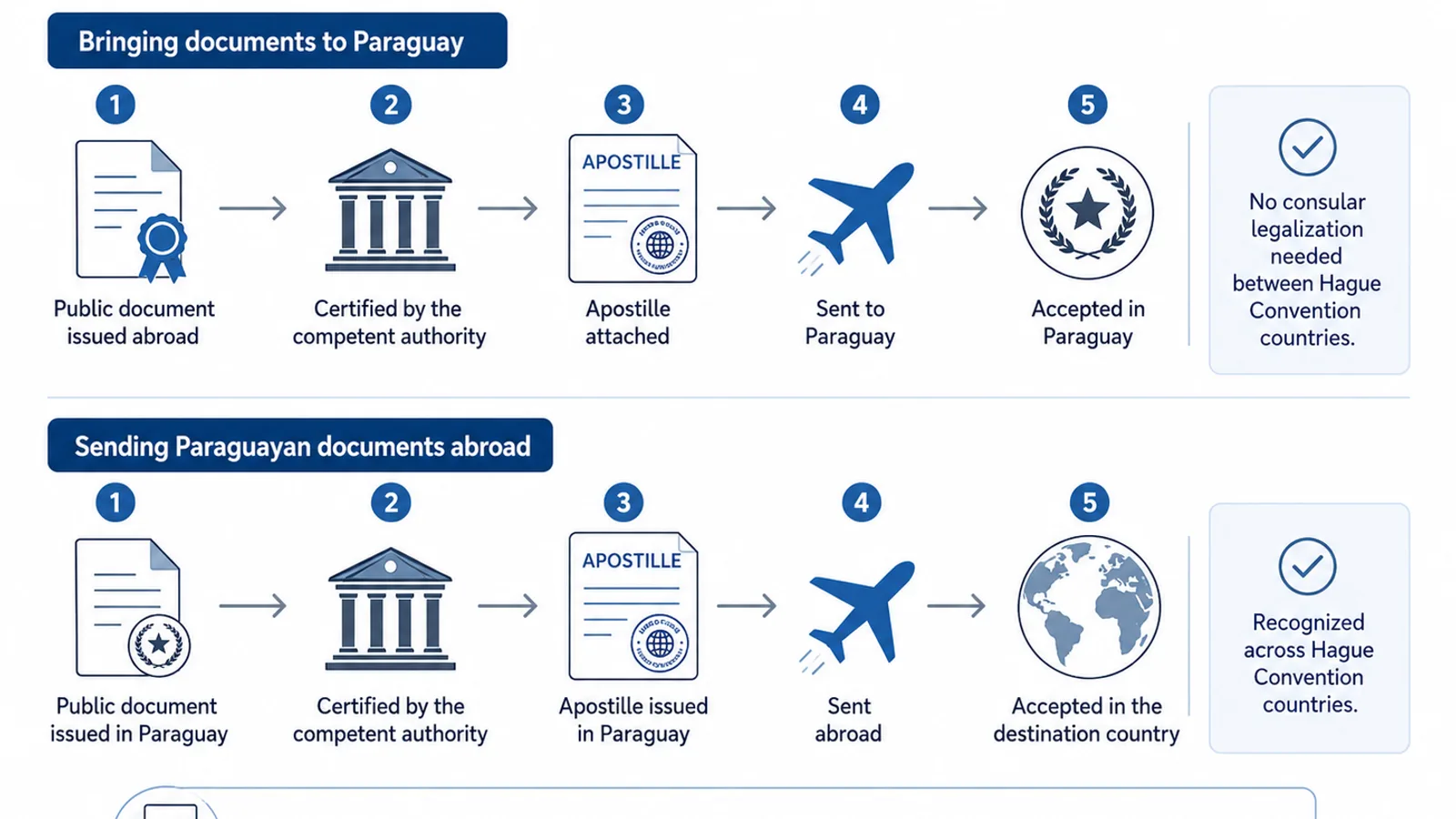
Apostilles become confusing because several document problems are often bundled into one word. A foreign resident may need a birth certificate, police record or diploma; the document may need an apostille; the text may need a Spanish translation; and the Paraguayan agency may impose its own age or format requirement.
Those are separate steps.
Under the Hague Apostille Convention, an apostille certifies the origin of a public document—typically the signature, the official's capacity and the seal or stamp. It does not certify that every statement inside the document is true, and it does not turn the document into a Paraguayan residence approval.
The first decision: where was the document issued?
For a foreign public document to be used in Paraguay, the normal starting point is the country that issued the document. A German birth certificate is prepared for international use through the competent German authority, not by asking Paraguay's Ministry of Foreign Affairs to apostille it after arrival.
Paraguay's immigration guidance states that foreign documents used in residence procedures must be legalized or apostilled as applicable. An apostille issued in another Hague Convention state is recognized without the old second diplomatic-legalization chain.
For a Paraguayan public document that will be used abroad, the direction reverses. Paraguay's Ministry of Foreign Affairs is the country's apostille authority, subject to any preliminary verification required for the type of document.
A four-way decision table
| Situation | Starting point |
|---|---|
| Foreign public document for use in Paraguay, issuing country is in the Hague system | Obtain the correct document and apostille from the issuing country's competent authority |
| Foreign public document for use in Paraguay, issuing country is outside the applicable Hague route | Confirm the traditional legalization chain with the receiving Paraguayan authority and relevant consular authorities |
| Paraguayan public document for use in another Hague country | Complete any required Paraguayan preliminary verification, then request the apostille from Paraguay's Ministry of Foreign Affairs |
| Paraguayan document for a country outside the applicable Hague route | Ask the destination authority which legalization chain it requires |
The Hague Conference maintains the authoritative directory of competent apostille authorities. That is a better starting point than a relocation blog naming an office that may have changed.
Translation is a separate layer
Paraguayan residence procedures generally require foreign-language documents to be translated into Spanish under the applicable rules. The apostille does not perform that translation.
The receiving agency should determine the sequence. In some procedures, both the document and apostille need to be understandable in Spanish. The authority may also specify who is qualified to translate. Before paying for a translation, confirm exactly which pages and certifications are required.
A useful mental model is:
Document → authentication/apostille → translation required by the receiving procedure → submission
But that order should not be applied blindly. The receiving authority's current checklist controls.
The age of the underlying document can matter
An applicant can correctly apostille the wrong version of a document. Residence procedures can require recent police records or other documents issued within a defined period. The fact that an apostille is valid authentication does not override a receiving agency's rule that the underlying certificate is too old for that procedure.
This is why the checklist should be confirmed before ordering expensive originals, courier shipments, apostilles and translations.
A residence-file example
For a foreign document going into a Paraguayan residence file, a robust sequence is:
- identify the exact document in the current Migraciones checklist;
- confirm whether there is an issue-date limit or required form;
- obtain the accepted original or certified version from the issuing authority;
- obtain the apostille or required legalization in the issuing country;
- arrange the Spanish translation in the form Migraciones accepts;
- submit the document together with its authentication and translation;
- keep a complete scan of the exact packet submitted.
This sequence avoids a common waste pattern: preparing an entire file from an old adviser checklist and discovering at the counter that the police certificate is outdated or the translation form is not accepted.
Paraguayan documents going abroad
For Paraguayan documents, the Ministry of Foreign Affairs publishes the apostille and legalization service. Some electronic civil or judicial documents can require a preliminary institutional validation before the ministry can authenticate them for foreign use.
The destination country still decides what it accepts. An apostille can solve the authentication step while the foreign university, registry, immigration office or court imposes separate translation, original-document or recency requirements.
Common mistakes that create duplicate work
Do not confuse notarization with an apostille. A notary can be part of the chain for some documents, but a notarized copy is not automatically internationally authenticated.
Do not detach an apostille from the document it authenticates. Do not assume every country participates in the same Hague procedure. Do not translate first simply because a service provider offers a package. And do not assume that because Paraguay accepts an apostille, the underlying document automatically satisfies the substantive requirement of the residence or other procedure.
The reliable rule is two-sided: the issuing jurisdiction authenticates the document; the receiving authority decides whether that document is the right one for the procedure. Most apostille problems come from solving only one side.