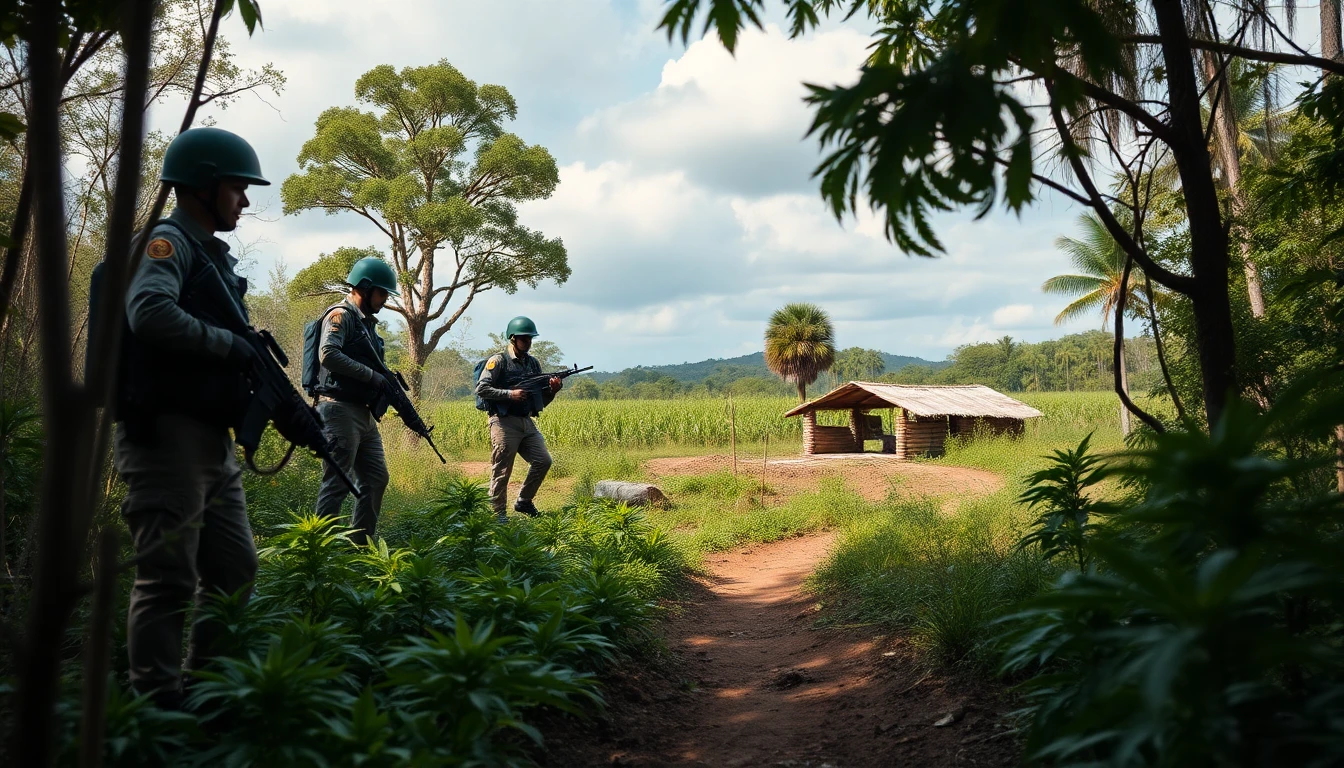
Operation Nueva Alianza 57 destroyed 222 hectares of marijuana plantations and dismantled 44 camps during 12 days of incursions in the Paraguayan departments of Canindeyú and Caaguazú. According to SENAD, the coordinated action by Paraguay and Brazil also eliminated 5,250 kilograms of processed drug and an estimated potential output of 666,000 kilograms.
The operation was coordinated by the National Anti-Drug Secretariat (SENAD), Paraguay’s institution responsible for combating drug trafficking, and Brazil’s Federal Police. The Internal Defense Operations Command (CODI), a unit of the Paraguayan Armed Forces, the Paraguayan Air Force and the Public Prosecutor’s Office also took part.
The teams carried out aerial and ground incursions in forested areas, where they located crops and structures used in the production process. The sites targeted included Mbaracayú Forest, Morombí, Caaguazú and Pindó Estate.
The production figures are estimates based on the potential of the destroyed plantations, added to the processed drug found during the operation. The 666,000 kilograms refer to the plantations’ estimated potential output, while the 5,250 kilograms were found as processed drug. The total of 671,250 kilograms is a calculated operational estimate, not a full seizure or a cash amount.
SENAD’s official financial assessment, calculated using prices on the Brazilian market, estimates losses of US$100,687,500 for criminal organizations. This amount represents interrupted potential revenue, not money seized.
The operation also exposed the overlap between illegal cultivation and conservation areas. Clearing land to plant marijuana leads to tree felling and ecosystem degradation, so destroying the crops affects both drug-trafficking production capacity and pressure on natural areas. For Paraguay, the result highlights the enforcement challenge of cultivation in conservation areas and leaves unresolved how to prevent the sites from being used again.
Canindeyú and Caaguazú are in Paraguay’s Eastern Region and form part of a border area marked by marijuana production intended in part for the Brazilian market. The operation involved Paraguayan actions in Paraguayan territory and cooperation from Brazil’s Federal Police.
The reported tally does not mention arrests, weapons seizures or the identification of the groups responsible for the camps. It also does not detail what measures will be taken to prevent the destroyed areas from being used for cultivation again.