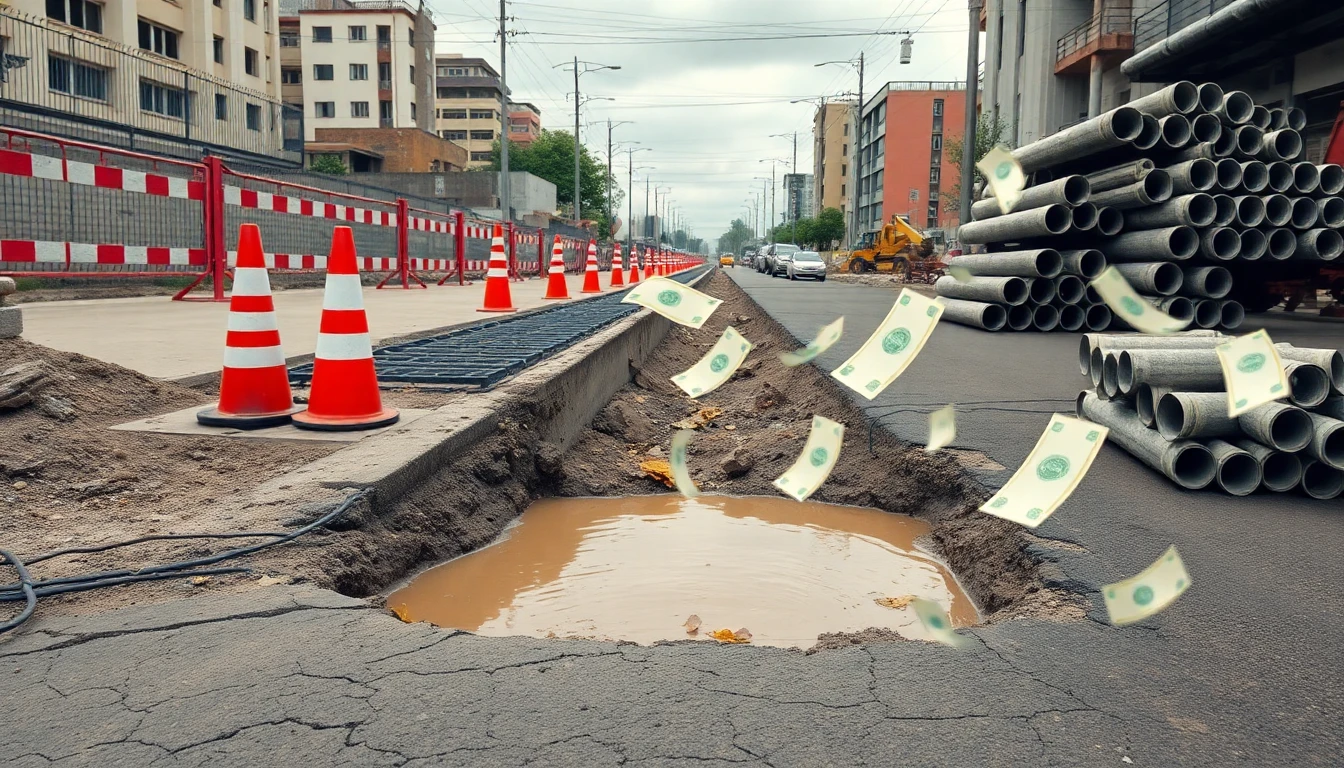
Taxpayers in Asunción paid approximately US$4.5 million between January and April 2026 in fees for the construction and maintenance of storm drains — services that, in most of the capital, simply do not exist. The amount represents 42% of what the city hall had projected to collect from this source over the entire year and is equivalent to more than 61% of the total collected in 2025, a full fiscal year.
Of the eight drainage basins promised by former mayor Óscar "Nenecho" Rodríguez (ANR-HC), only four have seen work begin. His successor, Luis Bello (ANR-HC), continues to levy the taxes, but the projects remain slow due to a lack of financial resources.
In the San Pablo neighborhood, work on the Lambaré and Itay basins has progressed 42% and 55%, respectively, more than two years after they began on April 10, 2024. The contracts were signed with Consorcio Pluvial Abasto (G. 71.393 million, with G. 36.701 million already paid) and with Consorcio CCC-Tecsul (G. 64.362 million, with G. 23.427 million paid).
In the Santo Domingo basin, physical progress stands at just 30%, nearly 15 months after work began on March 27, 2025. The contracted consortium, Consorcio Pluvial Santos, received G. 72.099 million, of which G. 17.871 million has already been paid. The works cover high-traffic areas in the Bella Vista, Manorá, Las Lomas, Carmelitas, and Santo Domingo neighborhoods.
In the Jara and Las Mercedes neighborhoods, corresponding to the General Santos and San Antonio basins, work has not even effectively begun. The groundbreaking ceremony took place on March 20, 2025, but 15 months later, the project remains stalled. Mayor Bello himself acknowledged that work had not started due to a lack of funds. The contracted contractor, TECO SRL, received G. 42.305 million, with G. 9.593 million already paid.
The package of eight basins was originally financed with resources from the so-called "G8 Bonds," issued in 2022 for G. 360 billion, with the promise of solving urban flooding. However, the money, which should have been earmarked exclusively for infrastructure works, was diverted to current expenses — primarily salary payments. Carlos Pereira, the appointed overseer, documented in a final report that, through "terrible illegal practices," such as the use of a "single account," Nenecho diverted G. 512 billion from the bond issuance. The shortfall left the storm drain projects unfunded and caused serious delays with infrastructure suppliers.
Nenecho resigned in August 2025, amid imminent removal from office and the publication of the report on his administration. His successor, Luis Bello, elected by the ruling majority on the Municipal Council, maintained the budgetary priority of salary payments. In the first four months of 2026, 70% of all municipal resources were allocated to the payroll, totaling more than G. 230.172 million — more than eight times what was invested in public works.
On employee bonuses alone, the city hall spent G. 29.239 million during the period, an amount exceeding the G. 27.754 million applied to road infrastructure. Waste collection and urban cleaning brought US$21 million into municipal coffers, but failed to prevent the capital from accumulating chronic deficits in essential services for the population.