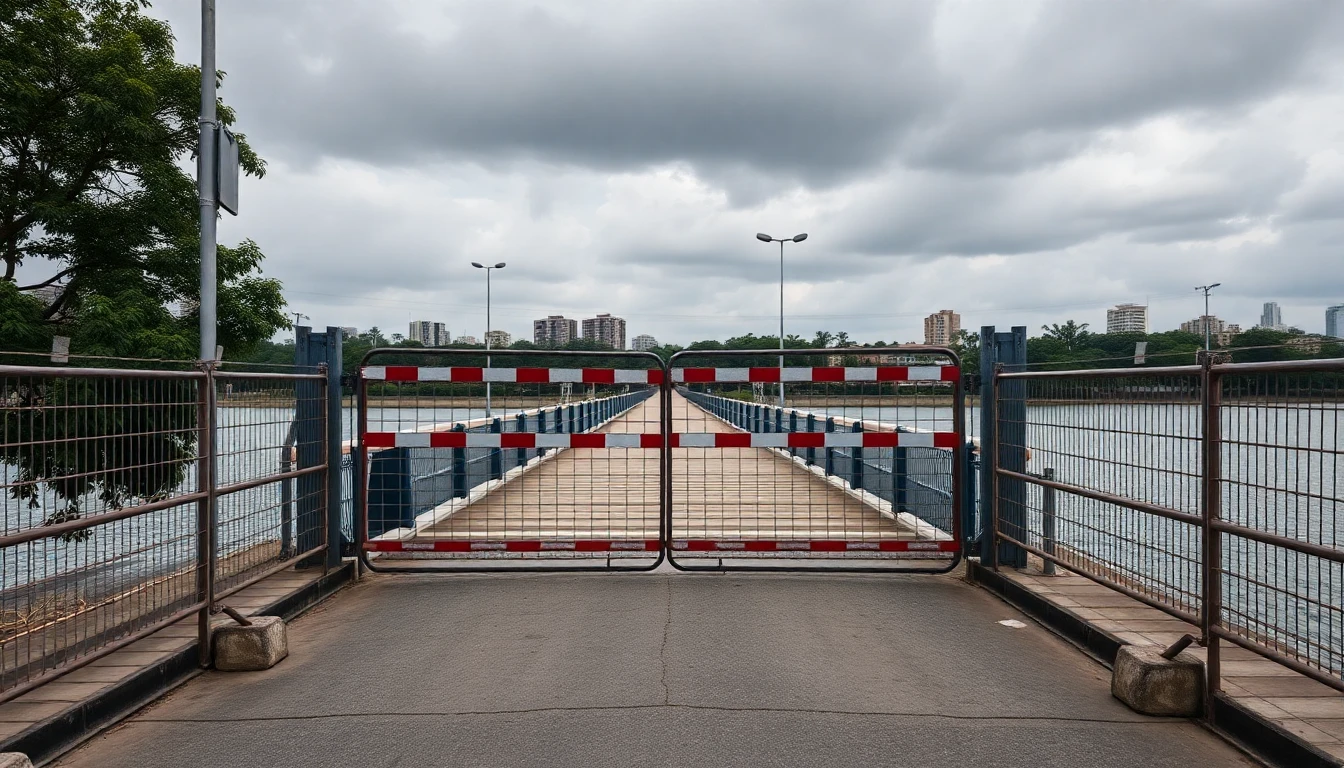
Argentina’s National Gendarmerie installed a padlocked iron gate on the La Fraternidad footbridge, a pedestrian connection between Nanawa, Paraguay, and Clorinda, Argentina. Access is allowed only from 7 a.m. to 7 p.m., physically reinforcing the time restriction maintained since measures adopted during the COVID-19 pandemic.
According to published reports, the structure was installed on Thursday afternoon, unexpectedly for residents and local authorities. The closure also prevents officers from making exceptional arrangements to let residents pass outside the official hours—a possibility that existed before the gate was installed.
Gustavo Núñez, a Nanawa councilor, said the measure harms the social and economic life of both cities and criticized the lack of dialogue with Argentine authorities. The Nanawa Municipal Council sent requests to Paraguay’s Ministry of Foreign Affairs, the Paraguayan consulate, the Clorinda municipal government and Argentina’s National Gendarmerie for 24-hour border service to be restored, but local authorities say they have received no favorable response.
The closure affects workers, shoppers and students who depend on daily traffic across the footbridge. Published reports say Argentine children and young people who live in Nanawa and study in Clorinda may use clandestine crossings to reach classes, while university students returning from Asunción at night find the official passage blocked.
When the official route is closed, residents use precarious wooden bridges and informal boats to cross the river. Núñez warned that the gate could shift the movement of people and smuggling to clandestine routes rather than eliminate them.
Ariel Caniza, mayor of Clorinda, said the decision was made by Javier Milei’s government and called it “arbitrary,” according to published statements. He also said the measure harms cross-border trade and encourages illegal crossings. Caniza linked the decision to political tensions between Milei and Gildo Insfrán, governor of Formosa province, but that interpretation has not been confirmed by an official justification made public.
Fernando Verón, president of the Nanawa Municipal Council, said local authorities are awaiting Paraguayan mediation, according to published statements. Representatives of Nanawa and Clorinda are expected to meet at 10 a.m. at the Nanawa Municipal Council headquarters to seek removal of the gate and discuss a return to uninterrupted operation.
The footbridge is one of the main points of movement between the cities, whose activity depends on the exchange of residents, workers and consumers. Núñez warned that the restriction could make crossings riskier for people who need to cross outside operating hours.