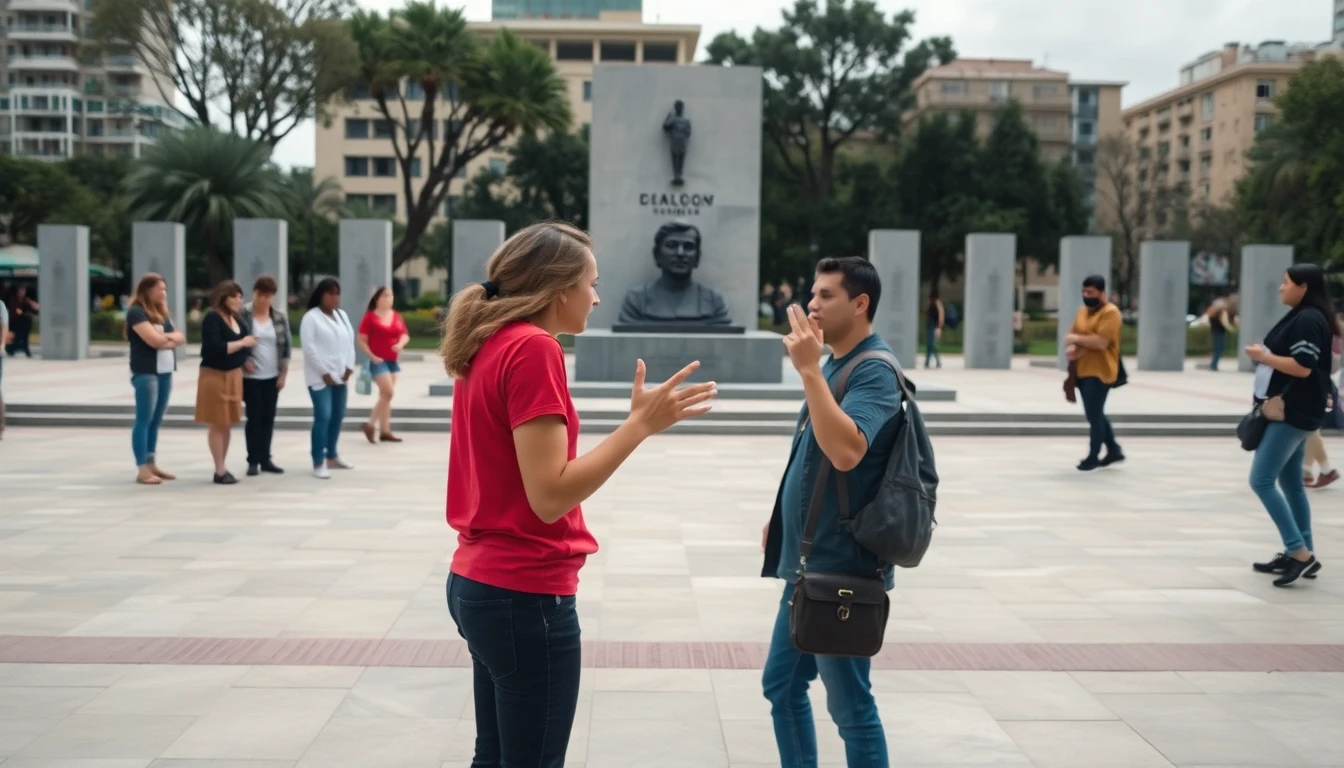
About 11 years old, a student from the Primera Escuela Paraguaya de Sordos asked in sign language why Paraguayans were persecuted during a historical-memory activity held on Friday morning at Plaza de los Desaparecidos in Asunción. The question was asked in front of victims of Alfredo Stroessner’s dictatorship and 16 students from the institution.
The visit was organized as part of the International Day of the Victims of Enforced Disappearances, observed on August 30. Néstor Vera, a veteran human rights activist, used the national doctors’ strike as an example: he explained that under Stroessner’s regime, people demanding better working conditions and a Paraguay free of human rights violations could be persecuted.
Rogelio Goiburú, an activist and son of doctor Agustín Goiburú, who disappeared during the dictatorship, and Celsa Ramírez, a victim of arbitrary detention and torture, also took part. In a conversation with Última Hora, Goiburú described the meeting as having reopened the human dimension of a period marked by violence and losses that remain unresolved for many families.
The Truth and Justice Commission, a body created in 2003 to investigate human rights violations in Paraguay between 1954 and 2003, recorded 20,090 direct victims of the dictatorship. Its survey lists 19,862 arbitrary or illegal detentions, 8,772 cases of torture, 59 killings by state terrorism, 336 disappearances and 3,470 forced political exiles. The report estimates that the number of affected relatives was around 107,987.
During the tour, the students saw Carlos Colombino’s Counter-Monument, made of concrete blocks that symbolically imprison Stroessner’s figure. The work honors the victims and, according to the description presented during the activity, serves as a symbolic reminder for denialist actors.
The project began in April as an initiative by teachers Rocío Duarte and Fátima Morínigo linked to Book Day activities and ended with the visit to the square. Director Gloria Ortigoza said the aim was to teach why the site is called Plaza de los Desaparecidos and explain concepts such as enforced disappearance and detention, bringing students closer to the country’s history. This article is part of a three-article series on historical memory.
The Primera Escuela Paraguaya de Sordos currently has 24 students; 90% are deaf or hard of hearing. The school also serves students with autism spectrum disorder and Guarani speakers. According to Ortigoza, the shortage of interpreters and the limited presence of sign language in institutions remain barriers to communication and inclusion.