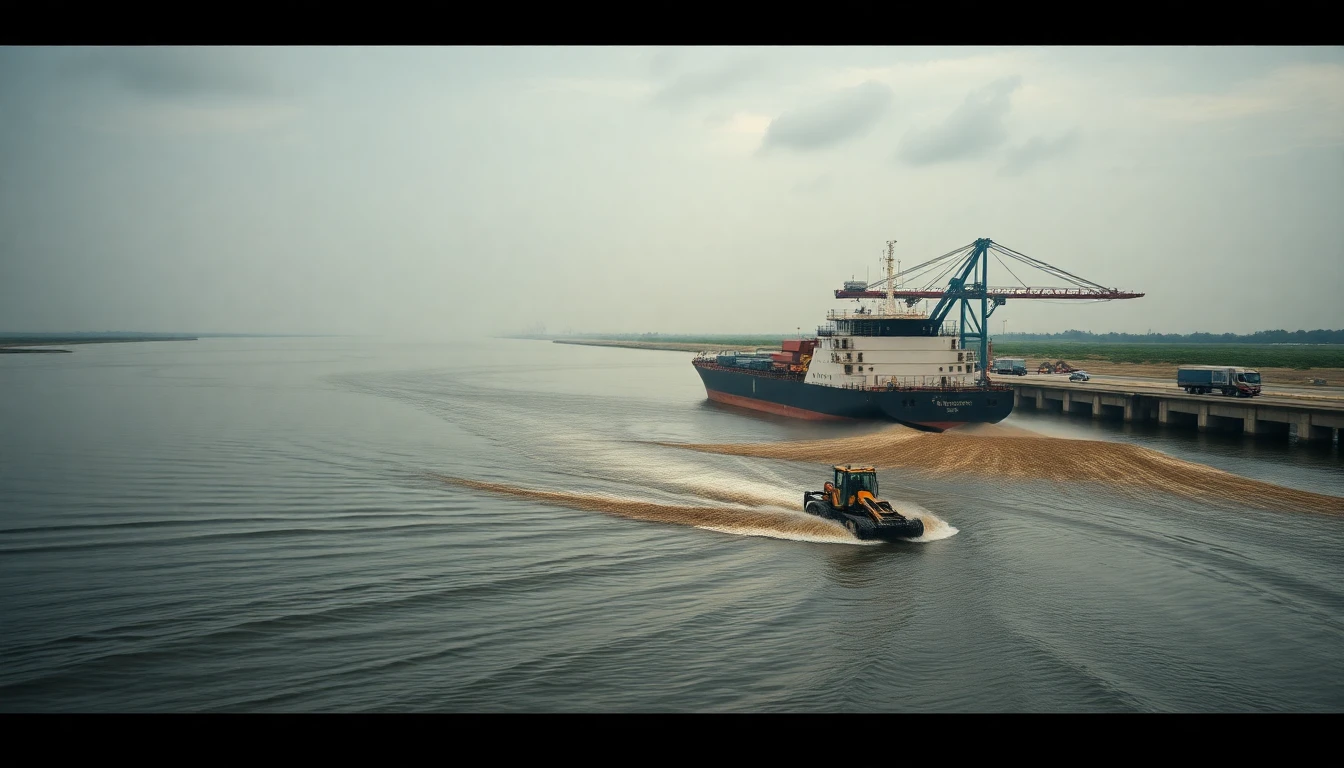
The expansion of private ports in Paraguay, driven by investment along the Paraguay and Paraná rivers over the past two decades, depends on public works to prevent logistical bottlenecks. Francisco Griñó Guillén, an engineer and member of the Paraguayan Chamber of the Construction Industry (Capaco), called for a permanent dredging program and better road access to the terminals.
According to Griñó, between 80% and 90% of Paraguay’s import and export cargo is transported by river. He described the waterway as “Paraguay’s most important highway” and said the state must keep pace with private expansion by investing in navigable channels, roads and local roads.
The engineer said there are currently three dredging contracts, but considered it insufficient to work only when severe drought occurs. “A dredging program must be established and carried out. If there is a problem, it cannot be resolved within days; sometimes it takes months,” he said.
The dependence also involves sections of the Paraná River under Argentine jurisdiction. In Griñó’s view, coordination with Argentina must be improved to ensure the maintenance of these shared areas. During recent periods of extreme drought, falling river levels forced vessels to navigate with about 70 centimeters less draft, reducing the amount of cargo carried on each trip.
The restrictions directly affect compliance with export and import deadlines. When navigation capacity declines, transport costs and times increase, putting pressure on companies that rely on the Paraguay-Paraná waterway to reach foreign markets.
The connection between production areas and ports is another critical point. Because Paraguay has no railways, virtually all cargo feeding the terminals arrives by truck. The lack of roads capable of supporting heavy traffic year-round increases pressure on the road network and can disrupt the flow even when the rivers are navigable.
Griñó, who joined Capaco in 1992 and served as the organization’s president for two terms, from 2002 to 2003 and from 2003 to 2004, will be honored at the Construction Gala, scheduled for September 17 in the convention hall of the Central Bank of Paraguay.