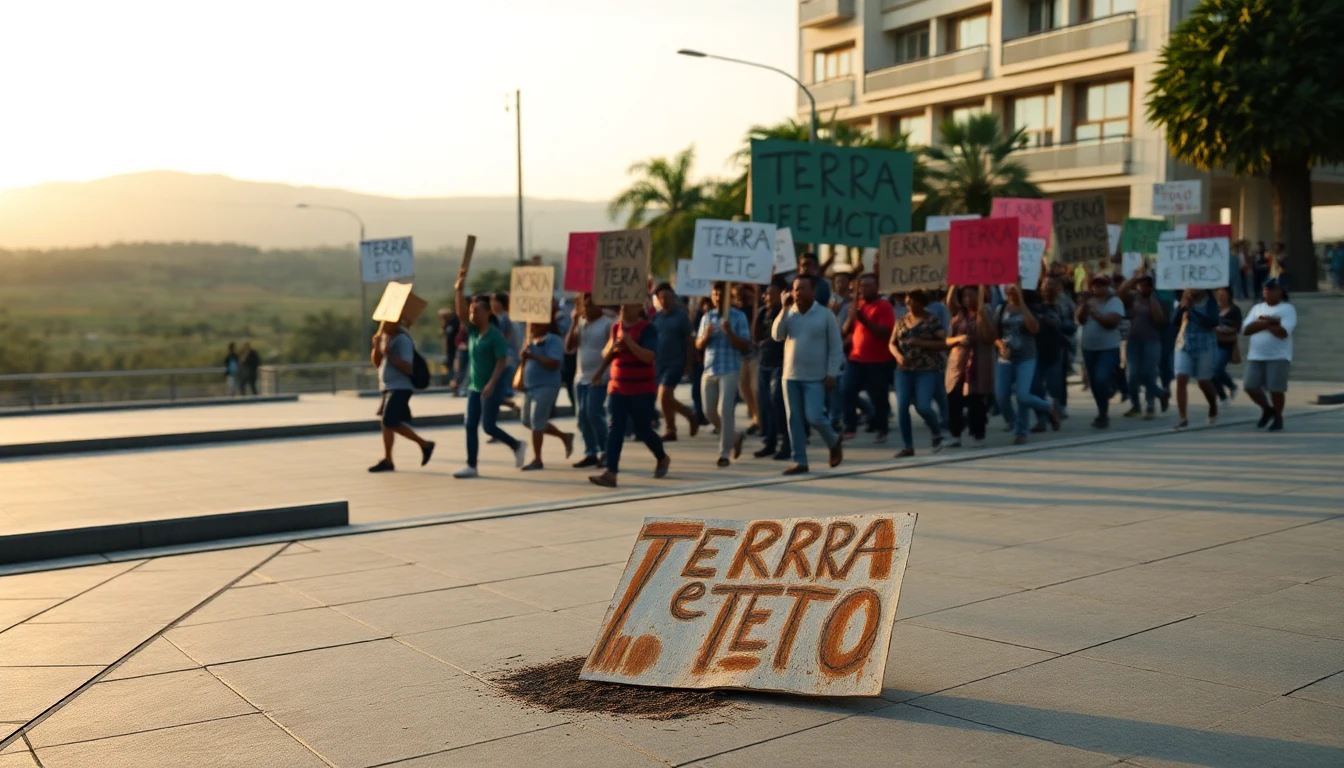
Thousands of farmers, Indigenous people, and residents of popular neighborhoods marched to the residence of President Santiago Peña in Asunción on August 19 to demand land reform, land titling, and adequate housing. The mobilization, organized by social movements and neighborhood committees, exposed the historical slowness of the Paraguayan state in land regularization.
The National Institute for Rural and Land Development (Indert), the agency responsible for agrarian policy, admitted that in 122 years of reform, it acquired nearly 5 million hectares but titled only 5% of these lands for their occupants. Francisco Ruiz Díaz, president of Indert, acknowledged that the institution operates at the limit of its operational capacity, with a budget equivalent to only 25% of the value available a few years ago.
Ruiz Díaz explained that Indert advanced in the delivery of titles over the last three years, formalizing about 4% of the lands under its management. However, the demand for regularization far exceeds current capacity. "Today, the farmers' demand for titling is much greater than our response capacity, not due to management problems but due to lack of resources," he stated in an interview with Radio Monumental 1080 AM. He estimated that an increase of 30 billion guaranis (about $21 million) in the budget would allow significantly expanding service capacity.
The president of Indert highlighted that the lack of land regularization generates economic losses equivalent to 2% of Paraguay's GDP, about $1 billion per year. On the other hand, the titling of rural properties can increase the productivity of small farmers by between 40% and 82%. "When we deliver a property title, the farmer gains access to credit and invests more in the land," he said.
Indert's files are still mostly analog, which delays processes. Ruiz Díaz cited the case of Coronel Oviedo, a city that developed on public lands not officially registered. "The problem of 122 years will not be solved in five. We need to digitize all files and processes to ensure transparency," he stated.
Despite limitations, Indert recorded a jump in the number of authorizations for popular housing construction, rising from 3,000 per year to 17,000 in 2026, with a projection to reach 22,000 in 2027. The agency maintains a permanent working table with the Multisectorial, a coalition of organizations that supports communities in project development.
Indigenous leaders also participated in the march and acknowledged Indert's progress but demanded more land. "They are satisfied with what we are doing, but say it is not enough. The problem is that the budget does not allow going further," summarized Ruiz Díaz.