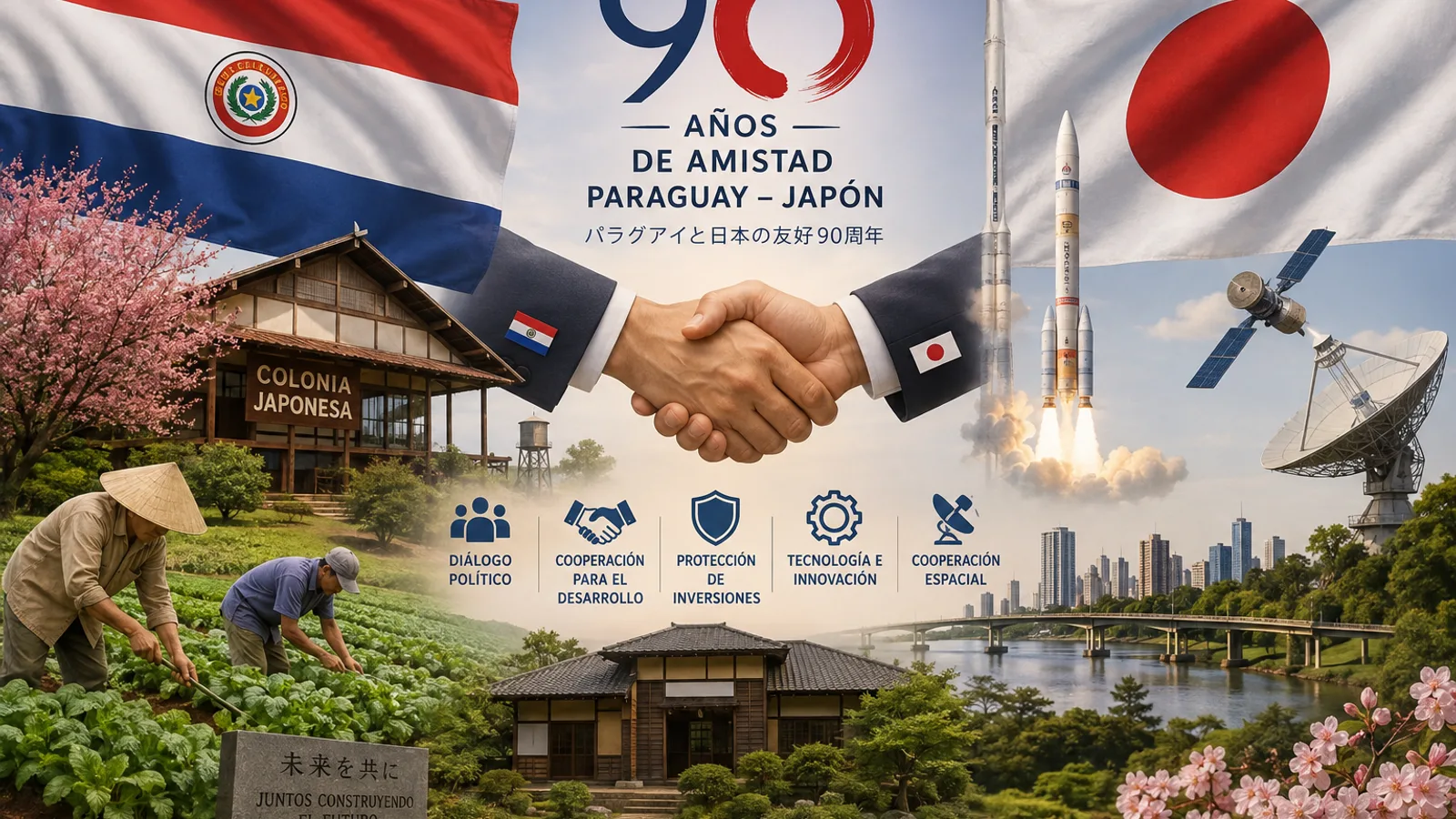
The August 2026 visit of Crown Prince Akishino and Crown Princess Kiko brought one of Paraguay's more unusual bilateral relationships into public view. The visit concluded on 24 August 2026 after meetings with President Santiago Peña, commemorations of the 90th anniversary of Japanese immigration and visits connected to the Nikkei communities of La Colmena and Yguazú. Pytagua had reported on the visit in advance: Pytagua report on the visit
The significance of the relationship is only partly explained by anniversaries and visits by members of the Japanese Imperial Family. Migration, agriculture and government development cooperation have become interconnected over decades. More recently, investment protection, space cooperation, infrastructure and an institutionalized foreign-policy dialogue have been added.
From La Colmena to Organized Immigration
Japan and Paraguay established diplomatic relations as early as 1919. Japanese immigration to Paraguay itself, however, began in 1936. The first families settled in La Colmena in the Department of Paraguarí. The Paraguayan government had initially authorized the admission of 100 Japanese families on a trial basis.
The first years were difficult: the settlers had to develop agricultural land while coping with inadequate infrastructure and, in some cases, serious crop problems. Further information on the history of Japanese immigration is provided by the Federación de Asociaciones Japonesas del Paraguay: Federation of Japanese Associations of Paraguay
World War II interrupted further immigration. After relations resumed, a second phase began in the 1950s. New Japanese settlements were established in Itapúa, Alto Paraná and Amambay, among other areas. These included La Paz, Pirapó and later Yguazú.
A decisive step was the Japan-Paraguay immigration agreement of 1959. It provided for an admission framework of up to 85,000 Japanese immigrants over a period of 30 years.
This figure is sometimes misunderstood as the actual number of Japanese migrants in Paraguay. It was, however, a contractually agreed upper limit. Actual immigration was considerably lower, partly because Japan’s rapid economic growth from the 1960s onward greatly reduced the willingness to emigrate. The agreement is documented here: JICA documentation of the immigration agreement
Today, Japan’s Ministry of Foreign Affairs estimates that around 10,000 people of Japanese descent live in Paraguay. It also recorded 3,778 Japanese nationals living in Paraguay in 2024. The two statistics cannot simply be added together because the groups may overlap. Japanese Ministry of Foreign Affairs
Agriculture as the Starting Point of Cooperation
The influence of Japanese immigrants is particularly closely linked to the development of Paraguayan agriculture. This is less about the introduction of a single crop than about cultivation methods, experimental farming, cooperatives, mechanization and the long-term organization of agricultural production.
One particularly well-documented example is the soybean. According to research by the JICA Ogata Research Institute, Japanese immigrants were among the pioneers of cooperative soybean cultivation in Paraguay and played an important role in its commercial establishment.
In 1960, 360 tons of Paraguayan soybeans were exported to Japan via Buenos Aires for the first time. Later, settlement areas strongly shaped by Japanese communities developed crop-rotation systems involving soybeans and wheat as well as other forms of diversified agriculture. A detailed JICA study on the subject is available here: JICA study on Japanese immigration and agriculture
It would therefore be too simplistic to attribute Paraguay’s later rise as a major soybean producer solely to Japanese immigration. The development had numerous economic, technological and international causes. The Japanese contribution during the early phases of commercial cultivation is, however, unusually well documented.
The Japanese settlements also developed cooperatives and local organizations. These sometimes took on responsibilities involving roads, social infrastructure and the organization of agricultural marketing. This created an early connection between private migration, community self-organization and later government development cooperation.
JICA as an Institutional Bridge
From this migration history, a long-term framework of government cooperation developed after 1959. Japan supported Paraguay in areas including agriculture, road construction, healthcare, education, vocational training and technical qualification.
A key role is played by the Japan International Cooperation Agency, or JICA. The Japanese Embassy in Paraguay provides an overview of this cooperation: Embassy of Japan in Paraguay
The scale is substantial. According to Japan’s Ministry of Foreign Affairs, cumulative economic cooperation through the Japanese fiscal year 2022 amounted to 173.2 billion yen in loans, 41.4 billion yen in grants and 91.3 billion yen in technical cooperation.
Together, this represents more than 305 billion yen over several decades. Japanese Ministry of Foreign Affairs
The priorities have changed in the process. While agricultural development and conventional infrastructure once dominated, technology, institutional capacity and specialized public services are now increasingly taking center stage.
In 2024, for example, Japan approved assistance of around 500 million yen for medical equipment for Paraguayan public healthcare institutions, including facilities of the Hospital de Clínicas in Asunción. Diplomatic Bluebook of Japan’s Ministry of Foreign Affairs
From Agriculture to Space
The breadth that cooperation has now reached was demonstrated by a visit by JICA President Akihiko Tanaka in 2023. In addition to agriculture and infrastructure, the discussions also covered renewable hydrogen, Japanese start-ups, human-resource development and space cooperation.
At the same time, a technical cooperation project with the Paraguayan Space Agency was being prepared that was intended, among other things, to improve the use of satellite technology and satellite data for socioeconomic development. JICA
In 2024, this became the Japan-Paraguay Space Cooperation Program. At the summit between President Santiago Peña and then Japanese Prime Minister Shigeru Ishiba in May 2025, both sides explicitly recognized the progress made in this cooperation. Japanese Ministry of Foreign Affairs
The program has since moved into physical infrastructure. On 4 September 2026, Paraguay and the Japan International Cooperation Agency signed the grant agreement for a satellite-technology facilities project worth approximately US$24 million. The plan includes a roughly 3,400-square-metre centre at the Universidad Nacional de Asunción campus in San Lorenzo, with laboratories for small-satellite development and geospatial-data use. Paraguayan Ministry of Foreign Affairs
This development in particular demonstrates the transformation of the relationship: a connection that arose substantially from agricultural migration has developed into cooperation that now extends to satellite technology and energy.
Infrastructure: The Hidrovía as a Current Example
A particularly visible example in 2026 is the new RM-5 “Paraguay”, a suction dredger donated by Japan for Paraguay’s waterways.
According to Paraguayan authorities, it can move around 1,500 cubic meters of sediment per hour. Japanese technicians trained Paraguayan personnel to operate it. Agencia IP
For a landlocked country whose foreign trade depends heavily on the Paraguay-Paraná Waterway, such support is economically more immediate than many symbolic development projects. It connects Japanese technology with one of the structural bottlenecks of the Paraguayan economy: the reliable navigability of its rivers.
The commissioning of the RM-5 was deliberately linked to the visit of the Japanese Crown Prince and Crown Princess in August 2026. The memory of migration and modern infrastructure policy therefore intersect directly.
From Friendship to a Formalized Partnership
The relationship has also become significantly more institutionalized at the political level in recent years.
At the summit in May 2025, both governments officially upgraded their relations to a “strategic partnership”. At the same time, they agreed on a mechanism for regular political consultations.
The first round of these consultations took place in Asunción as early as July 2025 and addressed economic affairs, development cooperation and international politics in addition to bilateral issues. Japanese Ministry of Foreign Affairs
Since June 1, 2025, Paraguayan citizens with biometric passports have been able to travel to Japan without a visa for short stays of up to 90 days. Paraguay had already previously granted Japanese nationals a corresponding exemption.
This also facilitated the movement of people institutionally — a noteworthy step in a relationship whose origins lie precisely in migration. Japanese Ministry of Foreign Affairs
A New Framework for Japanese Investment
At the same time, both governments are seeking to extend their traditionally close political and development cooperation more strongly toward private investment.
In December 2025, Japan and Paraguay signed an Agreement on the Promotion and Protection of Investments. Among other things, it contains rules on equal treatment of investors, protection against expropriation without compensation, capital transfers and the settlement of investment disputes.
Japan explicitly justified its interest by referring to Paraguay’s political and social stability, its Mercosur membership and its proximity to the Brazilian market. Japanese Ministry of Foreign Affairs
Paraguay completed its parliamentary consideration in 2026; President Peña promulgated the corresponding Law No. 7688 on July 31.
That step is now complete. Japan's Ministry of Foreign Affairs said it received Paraguay's notification confirming completion of the required domestic procedures on 28 August 2026 (27 August in Paraguay), and the agreement entered into force on 26 September 2026. The investment-protection framework is therefore no longer merely signed and approved; it is now in force. Japanese Ministry of Foreign Affairs
The economic relationship has so far been smaller than the political closeness might suggest. For 2024, Japan recorded Paraguayan exports worth 7.08 billion yen and Japanese exports to Paraguay worth 16.84 billion yen.
That is precisely why the investment agreement is interesting: the next phase of the relationship appears intended to be supported more strongly by companies and investment. Japanese Ministry of Foreign Affairs
Paraguay as a Link to Mercosur
There is also a regional dimension.
Japan and Mercosur created a Strategic Partnership Framework to deepen economic-policy dialogue, and the relationship moved another step in June 2026: on 30 June, the Mercosur member states and Japan formally announced the start of negotiations for an Economic Partnership Agreement. The joint framework says the negotiations are intended to cover trade and investment comprehensively while taking both sides' sensitivities into account. Paraguayan Ministry of Foreign Affairs
For Japan, Paraguay can therefore be interesting as a location between Brazil, Argentina and the other Mercosur states despite its comparatively small economy.
For Paraguay, Japan in turn offers access to capital, technology and one of Asia’s largest and most technologically advanced economic areas.
A Relationship That Began with Migration but Does Not End There
Japan-Paraguay relations differ from many other bilateral partnerships because of how they came about.
They were not built primarily around raw materials, major trade flows or geopolitical interests. The starting point was people who, from 1936 onward, developed land in Paraguay, founded communities and became a permanent part of Paraguayan society.
Trust emerged from this personal connection; institutional cooperation developed from that trust.
Migration was followed by technical assistance and development projects, and later by political consultations, visa-free travel, investment protection, space projects and cooperation on strategic infrastructure.
The visit of Crown Prince Akishino and Crown Princess Kiko for the 90th anniversary makes this historical continuity visible. More interesting than the ceremonies themselves, however, is what developed behind them:
Over nine decades, an immigration story has become a state partnership that today connects agriculture, infrastructure, science, business and foreign policy.