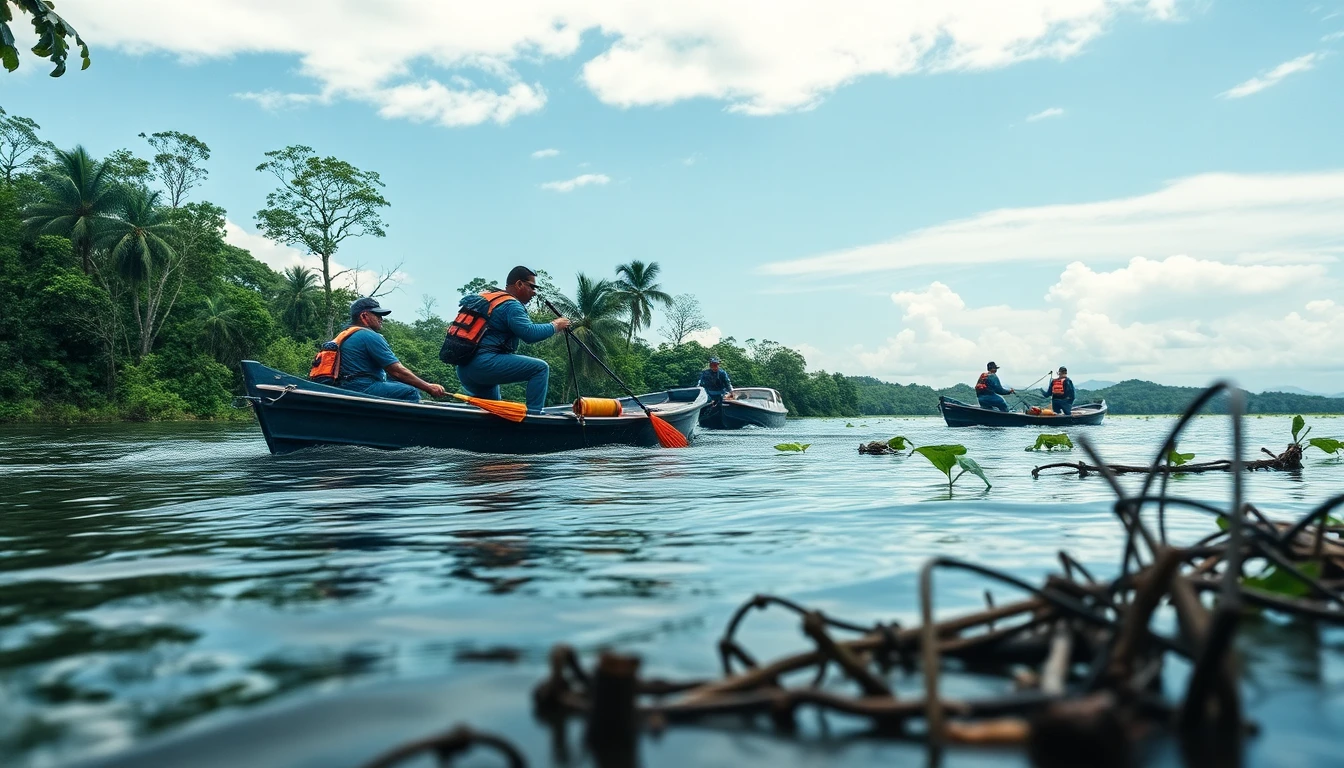
When the Itaipú reservoir began filling in October 1982, rescue teams travelled by boat through the rising Paraná River and flooded forest. They removed monkeys from treetops, collected armadillos, birds and tarantulas, and recovered thousands of snakes. Paraguay’s Operativo Mymba Kuéra was an extraordinary logistical undertaking. But telling the story solely as a conservation success would be misleading: the rescue became necessary because an enormous landscape was deliberately flooded to create the reservoir.
27,150 animals on the Paraguayan side
On 13 October 1982, the gates of the diversion channel were closed. According to Itaipú, heavy rainfall meant that the reservoir reached its intended level only 14 days later. Its water surface covers around 135,000 hectares, or 1,350 square kilometres.
On the Paraguayan side, agronomist Darío Pérez Chena led the wildlife operation. Itaipú reports that 27,150 animals were captured and relocated there. Pérez Chena told BBC News Mundo that snakes accounted for about 45 percent of the animals recovered, around half of them venomous. Monkeys, armadillos, birds and arachnids were also among the animals collected.
For the Brazilian side, the BBC report gives a figure of around 11,000 additional animals. Together, that would amount to just over 38,000, which explains why the operation is often described as having rescued “almost 39,000” animals. However, another official Itaipú historical account gives a combined total of 36,450. The available sources do not explain the discrepancy, so an exact overall total cannot be established with confidence from them.
Recovery did not eliminate the wider damage
Many animals were moved to protected areas within the same ecosystem. According to the BBC report, more than 100,000 hectares were available for relocation. Hundreds of snakes were sent to the Instituto Butantan in São Paulo for biological research and the production of antivenoms. Some six-banded armadillos were sent to Japan for scientific research.
The reports reviewed here do not provide a systematic long-term survival rate for the animals after release. Nor could the operation reach every animal. Pérez Chena himself acknowledged to the BBC that many more probably died. He specifically pointed to insects and species living in underground burrows that rescue crews could hardly reach.
The number of animals recovered therefore measures the scale of the rescue effort, not the total ecological loss caused by the flooding.
The reservoir also removed a natural barrier
The effects went far beyond terrestrial animals threatened by rising water. The reservoir submerged the Saltos del Guairá, known in Brazil as Sete Quedas. Itaipú’s own historical account describes protests by local residents as the falls disappeared. Along an approximately 170-kilometre stretch, the company says 8,519 urban and rural properties were flooded on the Brazilian side alone.
The falls also formed an important natural barrier for fish in the Paraná River. A long-term study published in the journal Neotropical Ichthyology in 2009 found that after Sete Quedas was submerged, at least 33 fish species native to the lower Paraná successfully colonised the upper Paraná. The researchers described a major change in the fish fauna and warned more broadly that reservoirs can remove natural biogeographic barriers.
Itaipú therefore changed more than terrestrial habitat. By flooding the falls, the project connected aquatic ecosystems that had previously been partly separated and altered the composition of fish communities for decades after construction.
A major rescue effort within a much larger intervention
None of this makes Mymba Kuéra insignificant. The teams worked under difficult and sometimes dangerous conditions and prevented the deaths of thousands of animals that had little chance of escaping the rapidly rising water. For Paraguay, a systematic wildlife operation on this scale was unprecedented.
But the two levels should be kept separate. Mymba Kuéra was a mitigation measure for an already approved and far-reaching environmental intervention. Saving individual animals could not reverse the loss and transformation of their habitats.
The operation therefore tells two stories at once: an extraordinary effort to save as many animals as possible during the flooding, and the limits of wildlife rescue when roughly 1,350 square kilometres of landscape are permanently transformed into a reservoir.