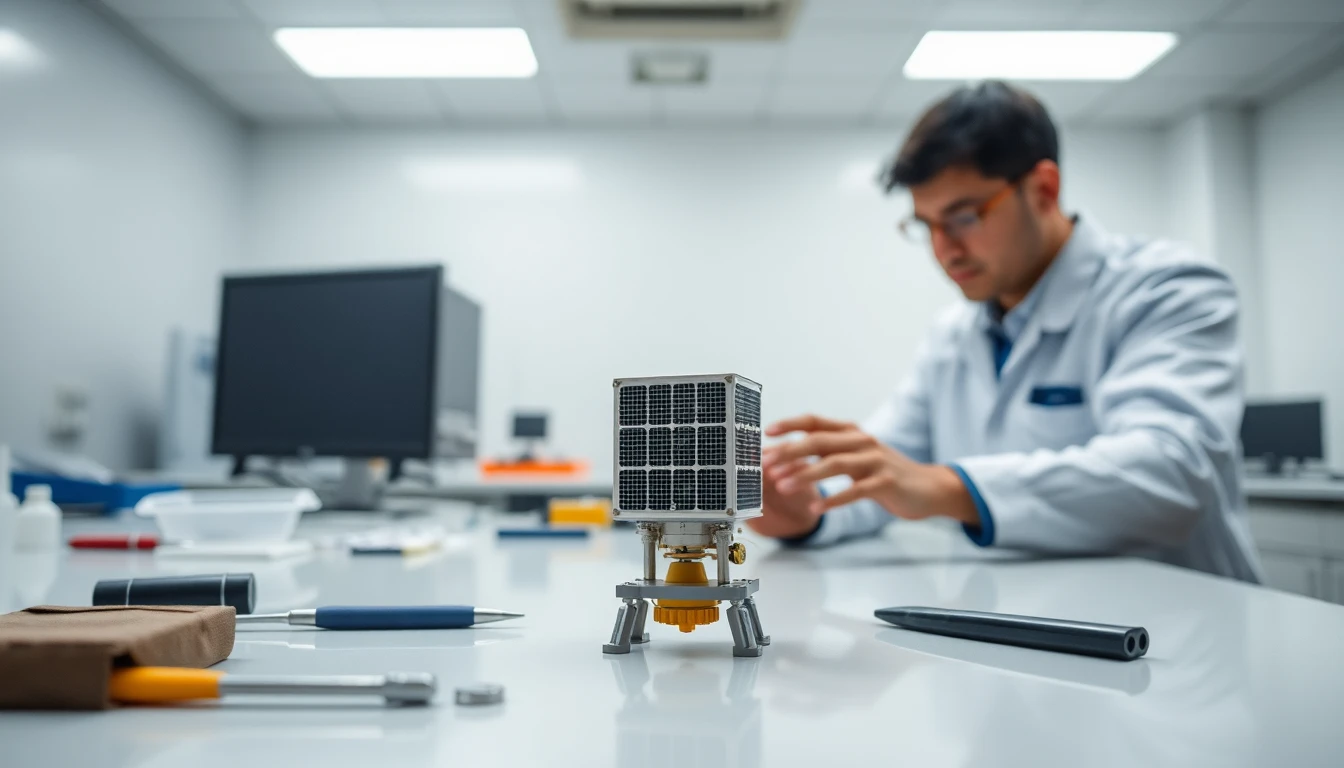
GuaraníSat-2, Paraguay's second satellite and the first built entirely in the country, is ready to be sent to the United States, where it will be integrated into the rocket that will carry it to space. The announcement was made by Adolfo Jara, Director General of Planning and Management of the Paraguayan Space Agency (AEP).
The satellite's development is the result of three years of work and cooperation involving national and international institutions. The team, composed of more than 40 people, mainly includes young people between 18 and 25 years old, many of them university students, along with AEP professionals. The participating Paraguayan institutions are the Faculty of Engineering of the National University of Asunción (UNA), the Catholic University Our Lady of the Assumption (UCA), and the Paraguayan-German University (UPP).
Internationally, the project has the collaboration of NASA's Jet Propulsion Laboratory (JPL), the Mexican Space Agency, the National Autonomous University of Mexico, an Italian company, and the Kyushu Institute of Technology, with support from the Japan International Cooperation Agency (JICA). The challenge of building a satellite locally arose after the return of the first group of Paraguayan professionals who trained in Japan in 2022.
GuaraníSat-2 will carry out scientific and academic missions. One of them, developed by the Faculty of Engineering at UNA, will study the Earth's magnetic field anomaly. The satellite will also provide services to the amateur radio community, transmitting and storing messages and data packets. Furthermore, it is equipped with a camera to capture images of Earth, which will be processed by a Snapdragon coprocessor, technology from the same family used by NASA in Mars exploration vehicles.
The next steps include a press conference at the National Council of Science and Technology (CONACYT) on August 14. On August 16, the team will travel to the US for the satellite's integration into the "Deployer," the device that will place it into orbit. The launch is scheduled for early October, depending on environmental conditions.
While preparing for the launch, the AEP is already working on GuaraníSat-3 and the construction of satellite development and integration laboratories in Paraguay. A donation of approximately 24 million dollars from the Japanese government, through JICA, was recently approved by law to finance these laboratories, which will be located at UNA's Campus 2. These facilities will allow for environmental testing to be conducted locally, which is currently done abroad, and eventually provide services to other countries in the region.
Jara highlighted that the development of GuaraníSat-2 has already allowed Paraguayan students to complete their final degree projects and participate in international conferences. "Space is no longer a utopia for our country, it is already a reality," he stated, emphasizing Paraguay's entry into the international space ecosystem.