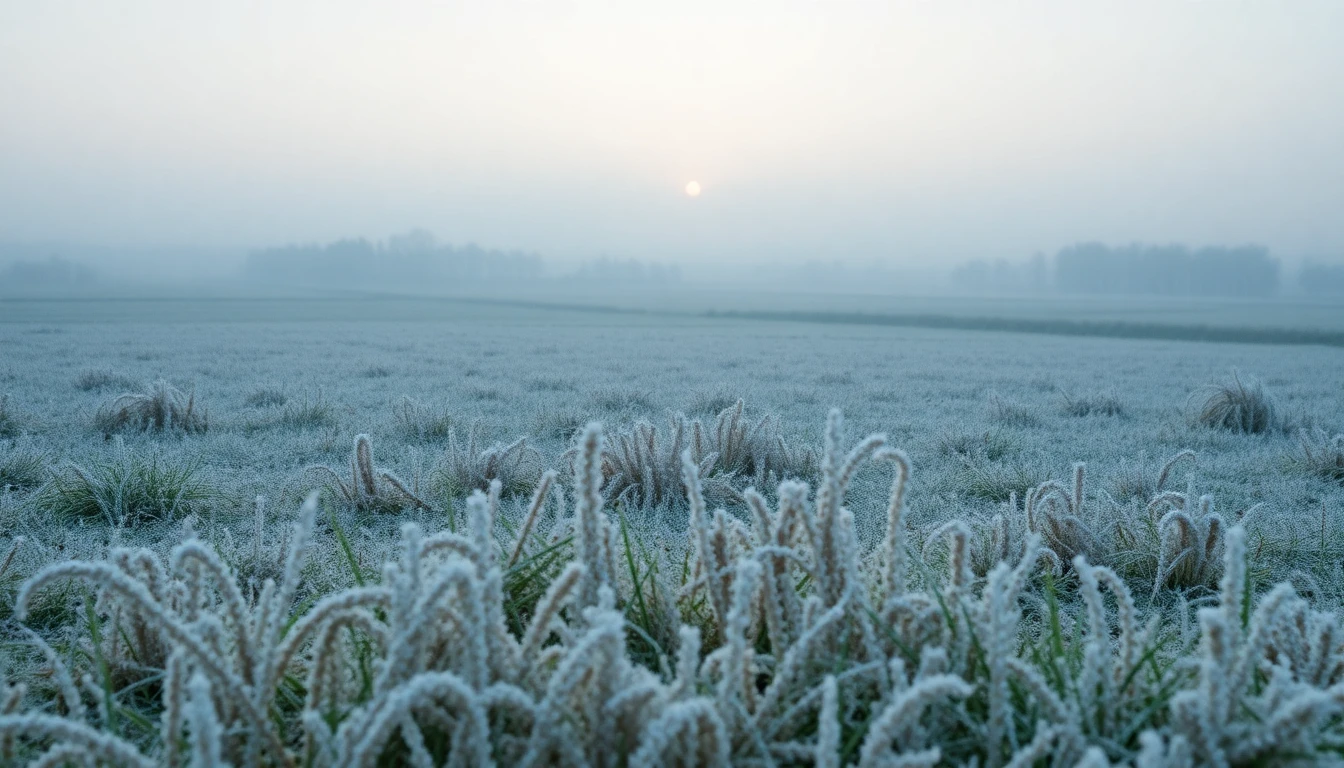
Despite its hot months, Paraguay has a real Southern Hemisphere winter, normally discussed as June through August, with shorter days, lower average temperatures and periodic incursions of cold air. Winter is mild on average but can bring frost and sub-zero temperatures. What Paraguay usually lacks is a long, continuously cold season of the kind familiar in northern or continental Europe.
That difference matters. A climate can have mild monthly averages and still produce cold waves, frost and occasional temperatures below zero. Monthly averages describe the centre of a distribution; they do not erase its extremes.
What an average winter looks like in Asunción
The following are historical 1971–2000 normals, not a current forecast. The World Meteorological Organization's city climatology, supplied through Paraguay's Dirección de Meteorología e Hidrología, gives Asunción mean daily minimums of 13.8°C in June, 13.1°C in July and 14.3°C in August, and mean daily maximums of 23.1°C, 23.2°C and 24.8°C.
Those values explain why foreign residents can experience a pleasant sunny afternoon in July and still want a jacket at breakfast. They also show why a comparison with Berlin, Toronto or Stockholm is wrong: an Asunción winter day is mild on average. But “mild” does not mean “absent.” The seasonal signal from January's normal 22.8°C minimum and 33.5°C maximum to July's 13.1°C and 23.2°C is substantial.
These normals have a dated reference period and represent one city. They should not be presented as a current national average. Paraguay spans the humid southeast, the central region and the Chaco; elevation, cloud, soil moisture, wind and the path of an arriving air mass produce different local outcomes.
Paraguay officially defines cold waves
The national meteorological service does not rely on a vague impression of “cold.” It defines a cold wave as at least three consecutive days in which both daily minimum and maximum temperatures fall below location-specific thresholds. The thresholds use the 10th percentile for a typical cold wave and the 5th percentile for a strong one, calculated from observations for 1981–2019.
For Asunción, the published typical thresholds are a minimum of 7°C and maximum of 17°C; the strong-event thresholds are 5°C and 15°C. In Encarnación, farther south, the corresponding thresholds are 3°C and 16°C for a typical event, and 1°C and 15°C for a strong event. Mariscal Estigarribia in the Chaco has higher thresholds—7°C and 19°C for a typical cold wave—because an unusual cold spell is defined relative to local climate.
This relative definition avoids a common mistake. A temperature that feels normal in a cold country can be an extreme event for a warm-climate location, its agriculture and its population. Cold-wave impact depends on departure from local conditions as well as the thermometer reading.
Frost and negative temperatures are documented
DMH's historical-extremes table records negative minimum temperatures at stations across Paraguay. Examples include −7.5°C at Pratts Gill on 13 July 2000, −5.1°C at Mariscal Estigarribia on 11 July 1942, −3°C at Ciudad del Este on 18 July 1975 and −1.8°C at Pedro Juan Caballero on 13 July 2000. A record is not a normal night, but it disproves the claim that freezing conditions cannot occur.
The 2024 climatological yearbook provides a more recent example. Frost and ground frost occurred at several locations during June, July and August, and the year's lowest reported minimum was −1.6°C at General Bruguez on 10 August. The same year also produced 44.2°C at Mariscal Estigarribia in December. Paraguay's defining feature is not unbroken heat; it is a large thermal range and sharp variability.
Cold does not always wait for the calendar. On 12 May 2026, before meteorological winter, DMH reported 11 new daily-minimum records as very cold air reached its station network. A single event does not establish a climate trend, but it shows why residents should follow forecasts in autumn as well as winter.
Why the change can feel abrupt
Paraguay has no mountain wall immediately to its south. Cold air masses can advance northward through the South American lowlands behind fronts. Temperatures may fall rapidly after a warm day, then rebound when northerly flow returns. This produces winters that are episodic rather than uniformly cold.
That pattern generates two opposite anecdotes: a visitor who experienced 30°C in August says there is no winter; someone who encountered frost says Paraguay is much colder than advertised. Both describe weather. Climate requires the full distribution—normal conditions, frequency, duration and extremes.
North, south and city are not interchangeable
The Chaco is famous for extreme heat, yet its stations also hold some of the country's lowest historical readings. Dry air and clear nights can favour large day-to-night changes. Southern and southeastern locations generally face a higher frost risk, while dense urban surfaces can keep central city temperatures above nearby open or rural sites.
For a household, the relevant question is not “What is Paraguay's winter temperature?” but “What do the nearest reliable station and forecast say for this location?” An apartment in central Asunción, an exposed farm in Itapúa and a house in the Chaco do not have the same risk.
Rain changes too
In the WMO's 1971–2000 Asunción normals, July had 39.4 millimetres of rain and four precipitation days, compared with 147.2 millimetres and eight days in January. June and August were wetter than July but still formed part of the cooler winter pattern. DMH's (Dirección de Meteorología e Hidrología) 2024 yearbook likewise identified July as the year's driest month, with less than 10 millimetres at several stations.
One year's dryness is not the same as a permanent rule, and Paraguay can still receive winter rain. The practical point is that cooler weather, dry vegetation, wind and local water conditions can combine differently from the hot, convective summer regime.
What newcomers should prepare for
- Use layers. The same day can begin cold and become mild or warm by afternoon.
- Check the actual building. Ask about sun exposure, drafts, hot water, safe heating and electrical capacity rather than assuming the climate makes them irrelevant.
- Follow DMH forecasts and warnings. Long-term averages cannot replace a forecast during a frontal passage.
- Protect vulnerable people. Infants, older adults, people with illness and those without adequate shelter can be affected even when the temperature seems moderate by foreign standards.
- Plan for animals and plants. Frost risk is local; agricultural decisions need station and technical guidance, not a countrywide slogan.
- Do not use improvised combustion heaters indoors. Fire and carbon-monoxide risks do not disappear in a short cold spell.
Does climate change eliminate winter?
Rising mean temperatures do not mean every cold outbreak vanishes. Climate change shifts distributions and affects heat risk, rainfall and extremes, while short-term circulation can still deliver unusually cold air. A record warm month and a damaging frost can occur in the same broader warming climate.
Neither one cold morning nor one hot winter afternoon proves or disproves a trend. Trend analysis requires consistent station series, quality control and a defined baseline. DMH and international climate datasets provide the appropriate tools; social-media memories do not.
The verdict
The accurate statement is: Paraguay has a generally mild, highly variable winter with intermittent cold waves and real frost risk. Snow and prolonged freezing are exceptional, not the seasonal norm. Warm afternoons are common. So are sharp changes, and official records below zero exist in multiple regions.
Paraguay's winter is shorter and warmer than many foreigners know, but it is real. Residents, farmers and travellers should therefore plan for cold mornings, frost and changeable weather.