Paraguay tightens solvency rules for permanent residence applicants

Paraguay's Resolution DNM No. 407 changes the permanent-residence solvency test from a generic document exercise into a consistency test: the evidence should show how the applicant actually supports themself and should match the activity declared to Migraciones.

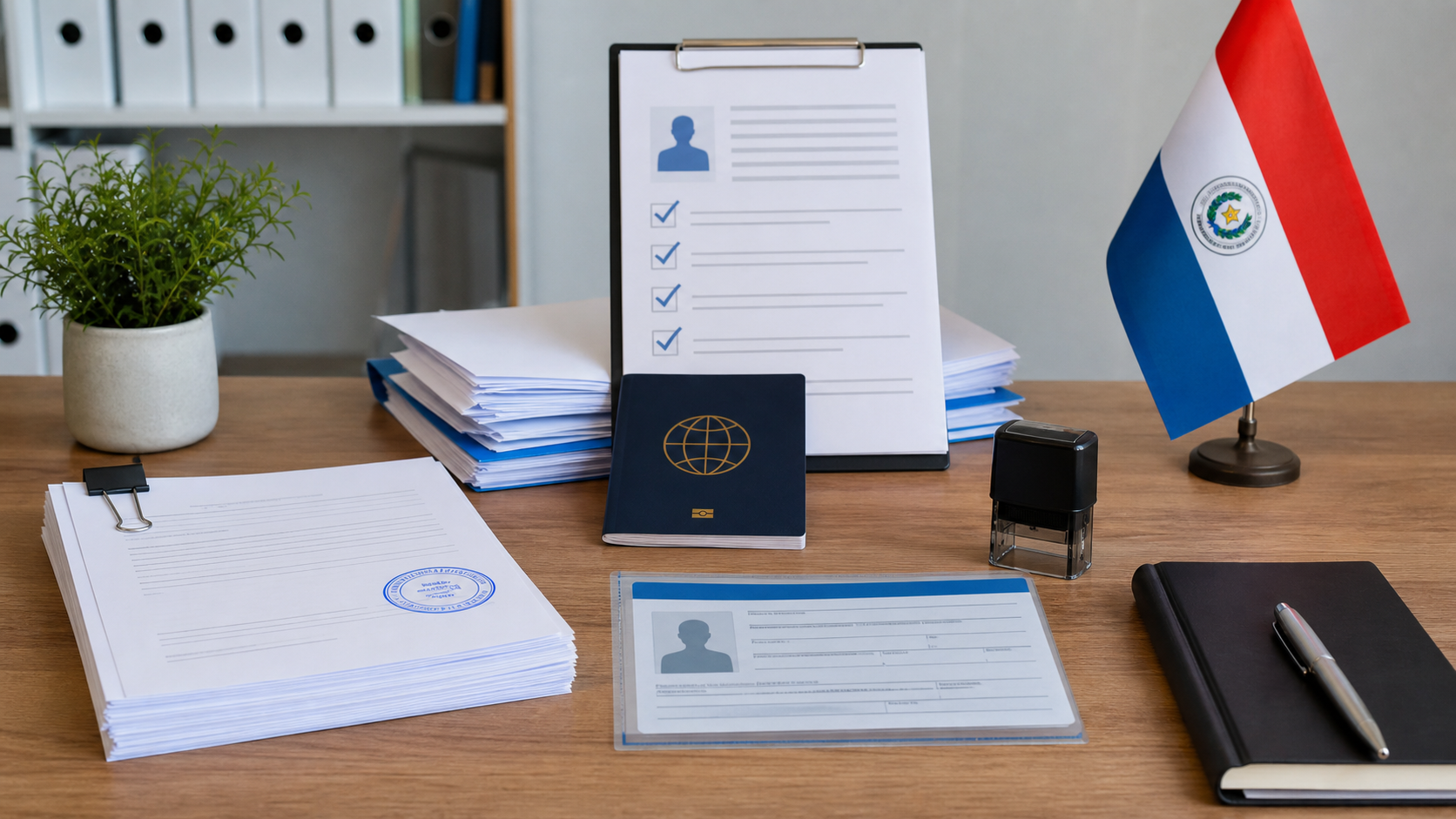
Paraguay residence paperwork arranged on an administrative desk
Illustration of documentation for Paraguay permanent residence solvency checks.Photo: Pytagua / Pytagua generated image (own-work)

Paraguay approved tighter economic-solvency rules for permanent residence on 28 May 2026, and Migraciones said they would apply to applications filed from 6 July 2026. The important change is not that every applicant suddenly needs the same bank balance. It is almost the opposite: Migraciones now asks for evidence that fits the applicant's real economic situation.

Resolution DNM No. 407, signed on 28 May 2026, consolidates the solvency criteria used by the Dirección Nacional de Migraciones (DNM) and instructs the agency to apply them in permanent-residence files. That includes people changing from temporary to permanent residence under Law 6984/2022 and the applicable Mercosur route.

What changed in practice

The resolution makes three ideas explicit: the evidence must be suitable, sufficient and verifiable; it should demonstrate real income, means of subsistence or accessible economic resources; and it should be consistent with the profession or activity the applicant previously declared.

That last point is the one most likely to create friction. A person who entered the temporary-residence process as an employee, independent professional, remote worker or property owner should not assume that any unrelated asset will automatically satisfy the permanent-residence review. Migraciones can compare the new evidence with the earlier file.

The change therefore rewards a coherent paper trail more than a thick paper trail.

The evidence depends on the activity

Resolution 407 separates applicants into categories rather than prescribing one universal solvency document. The public rules identify professionals and technicians, employees, independent workers, remote workers or digital nomads, property owners, company shareholders, farmers, religious workers, retirees, dependents and students, among others.

A useful way to read the annex is this:

SituationWhat Migraciones is trying to verifyEvidence specifically highlighted in the public rules
Professional or technicianThe qualification is actually connected to current economic activityActive work and income; examples include IPS records, qualifying employment documentation or recent tax declarations
Remote worker / digital nomadThe foreign or remote activity is real and produces incomeContract or service agreement, together with evidence of income and the payment method
Property ownerThe property right exists and can plausibly support the declared meansRegistered title; Migraciones may still request evidence of income generated by the property
Student or dependentAnother person or source genuinely provides the means of supportEvidence of funds, income or family sponsorship, with supporting documentation
Other declared activitiesThe applicant's current means fit the category used in the residence fileCategory-specific evidence under the annex and any additional verification requested by DNM

A university or technical degree by itself is therefore no longer a safe answer to the solvency question. It proves training; it does not prove that the applicant is currently earning or has sufficient resources.

Foreign documents create a second test

Evidence can be economically convincing and still fail as a document. Foreign-issued contracts, certificates or other public documents may need legalization or an apostille and, where they are not in Spanish, a Spanish translation under the applicable rules.

Applicants should separate two questions before spending money on paperwork: Does this document prove the economic fact Migraciones wants? And is this the version and form Migraciones will accept? Apostilling a weak document only produces an authenticated weak document.

This is particularly relevant for remote workers. A service contract may show the legal relationship but say little about whether payments are actually being received. Conversely, bank transfers without a comprehensible contract can leave the agency unable to connect the income to the declared activity. The strongest file normally lets the reviewer follow the chain from activity to agreement to payment.

What did not change

Resolution 407 did not create a new permanent-residence deadline. Migraciones continues to publish the change-of-category window as the 90 days before temporary residence expires and up to 30 days afterward, with the applicable fine for a late filing.

That timing should be treated as the outer legal window, not a document-preparation schedule. Police records, civil documents, apostilles, translations, tax filings or employment evidence can take time to obtain. An applicant who begins only when the residence card is about to expire has less room to correct a mismatch.

Four common weak points

The document proves status, not solvency. A degree proves education. A share certificate proves an ownership interest. A property title proves ownership. None automatically proves sufficient current means.

The evidence contradicts the earlier file. A temporary-residence application may describe one activity while the permanent-residence file suddenly relies on another. That can be legitimate, but the change should be explainable and documented rather than left for the reviewer to infer.

The income cannot be traced. Contracts, invoices, tax filings and incoming payments should tell the same story where those documents are relevant to the category.

The foreign document is prepared before the checklist is confirmed. Applicants can spend heavily on apostilles and translations that are unnecessary, too old for the procedure or not the evidence DNM actually needs.

A better preparation sequence

Start with the temporary-residence file and write down the profession or activity previously declared. Then identify the category in Resolution 407 that best matches the applicant's current situation. Build a short evidence chain around that category rather than collecting every financial document available.

Before filing, check five things: the residence expiry date; the current DNM checklist; whether the activity in the evidence matches the migration record; whether foreign documents need apostille or legalization and translation; and whether the documents show actual income or resources rather than only a legal status.

The new solvency regime is stricter mainly because it is more specific. Applicants who can explain, document and verify how they support themselves should be in a stronger position than applicants relying on a generic certificate that does not answer that question.

Share WhatsApp Facebook LinkedIn

Sources (6)

Updated: Jun 10, 2026, 5:10 PM