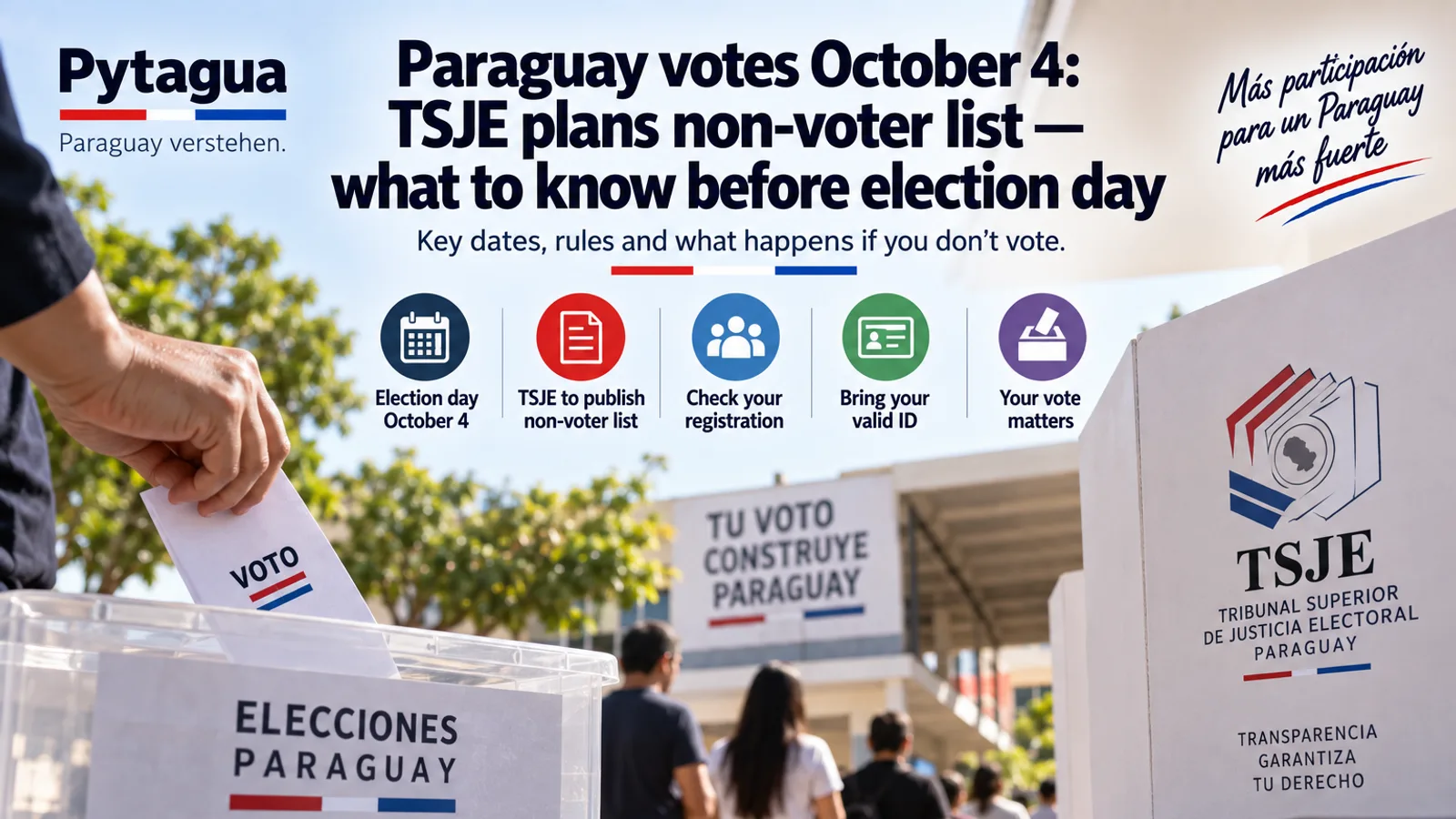
Paraguay will hold nationwide municipal elections on Sunday, October 4, 2026. Two days before the vote, Luis Alberto Mauro, an adviser to the Tribunal Superior de Justicia Electoral (TSJE), Paraguay’s highest electoral court, said the authority plans to use polling-table records after the election to compile a list of people recorded as not voting and publish their names, surnames and identity-card numbers on its website.
That announcement is only one part of what matters for election day. According to official TSJE logistics data, 5,043,154 people are eligible to vote. The election covers 263 districts, with 14,711 polling tables in 1,187 voting locations. Voters will elect 263 mayors and municipal-board members for the 2026–2031 term.
Voting hours, ID and polling place
Voting is scheduled from 07:00 to 17:00 on October 4. The TSJE says the physical Paraguayan identity card is the only document valid for voting, and it may be current or expired. Voters can check their assigned polling location, table number and order in the electoral roll at https://padron.tsje.gov.py.
The official electoral-propaganda period ended at 23:59 on October 1. The TSJE has also announced international observation by several electoral organizations, including the Organization of American States.
Preliminary results are not the final count
After polls close, the TSJE will operate the Transmisión de Resultados Electorales Preliminares (TREP), or Preliminary Electoral Results Transmission system. The TSJE describes TREP as unofficial and non-binding. It expects preliminary results to be substantially available at about 20:00 on election night. Binding results come later through the review of election records and the official computation by the competent electoral courts.
What the planned non-voter list means
In a 1000 Noticias report published October 2, Mauro said the TSJE would use the polling tables’ “voted/did not vote” records to compile the list. He described publication as a form of “moral sanction.”
Publication of an initial list is not automatically the same thing as a final fine. Resolution 145/2023 established the TSJE’s procedure for applying the sanction provided by Article 332 of the Electoral Code. The way the rule was applied after the 2023 general election shows electoral judges publishing lists together with separate periods and locations for submitting justifications.
Mauro cited illness, travel abroad and work that required a person to be more than 50 kilometers from the assigned polling place as examples of possible justifications. Whether a particular justification is accepted is decided through the applicable procedure, so an absence recorded at the polling table is not by itself a final determination of liability.
The fine is tied to one minimum daily wage
For unjustified failure to vote, the Electoral Code provides for a fine equal to one minimum daily wage. Since July 2026, the general minimum daily wage published by the Ministry of Labor, Employment and Social Security is G. 117,077. Mauro rounded the figure to G. 117,000 in the interview.
Mauro also said that, in his view, current legislation lacks an effective mechanism to force payment; earlier proposals such as blocking identity-card or passport renewals did not become law. For voters, it is therefore important to distinguish three different stages: being recorded as not voting, a later opportunity to justify the absence, and any fine that is ultimately imposed through the formal process.
For October 4 itself, the practical steps are simpler: check the polling place and table, bring the physical identity card, and attend during the 07:00–17:00 voting period. Any non-voter procedure begins only after election day.