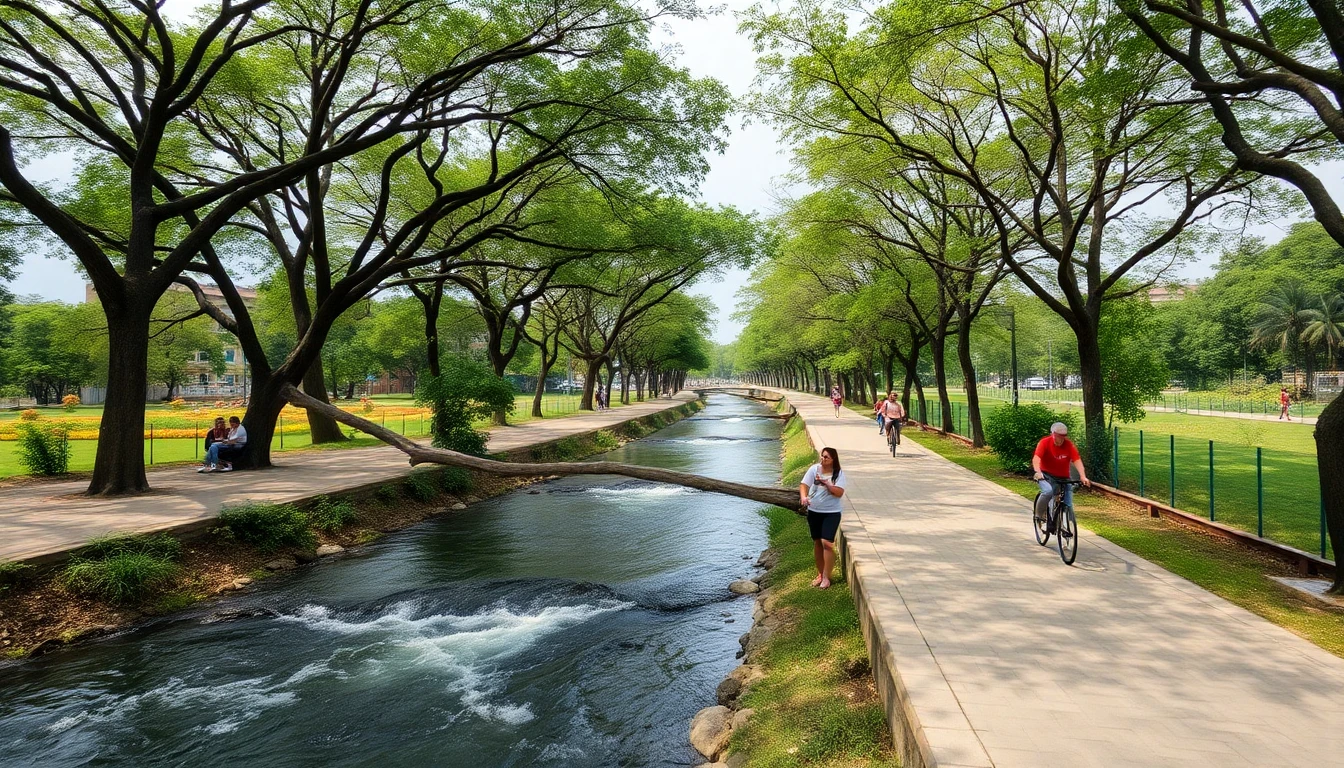
A citizen proposal presented by attorney Rosa Vacchetta calls for restoring the Ferreira and Mburicaó streams in Asunción with linear parks, bike paths, tree-lined sidewalks and social housing. The initiative estimates 24 kilometers of public spaces along the two waterways—seven kilometers along the Ferreira and 17 kilometers planned for the Mburicaó, whose length is described in the same proposal as more than 16 kilometers. These dimensions, routes and features belong to Vacchetta’s proposal, not to an approved government plan.
The idea is to use the public easements established by the Water Resources Law, with five meters on each bank. The design allocates 1.80 meters for the bike path and 3.20 meters for sidewalks, native landscaping and urban amenities. Implementation could begin along the Ferreira, from its source in the Ana Díaz area, through San Vicente, Obrero, Roberto L. Petit and Santa Ana, to the Costanera Sur, in connected stages. Possible participation by the Ministry of Urbanism, Housing and Habitat (MUVH) and the Ministry of Public Works and Communications (MOPC) is also part of the proposal.
Besides reducing exposure to flooding, the proposal seeks to create alternative routes for nonmotorized travel. Traffic entering and leaving Asunción is concentrated on six main avenues, which are identified as congested. Because the waterways cross these thoroughfares, their banks could form corridors for bicycles and pedestrians and ease some of the road network’s bottlenecks.
Asunción has 25 watersheds, 17 of them in the urban area, but only four streams remain visible and without significant changes to their courses, according to the presentation. Construction over the streambeds and the closing of natural sections make drainage more difficult; during heavy rain, water spills onto streets built over areas that have been channeled or covered.
According to Vacchetta’s assessment, the Ferreira is the capital’s second-largest stream by flow and experiences frequent overflows and landslides. She attributes the increased water speed and possible bridge damage to channeling and confinement in the upper section. In Vacchetta’s assessment, the Mburicaó, which crosses several neighborhoods, carries the greatest direct discharge of industrial and household pollution into the lower basin along the Paraguay River. The available material provides no independent corroboration of these claims.
Vacchetta also said that the Paraguayan Sanitation Services Company (Essap), the state-owned entity responsible for water supply and sanitation, discharges untreated effluent into the streams. The supplied interview excerpt is incomplete, and no independent confirmation of the allegation is available.
Removing homes built along the banks is one of the project’s obstacles. Vacchetta advocates housing buildings in the surrounding area itself, rather than moving families to distant peripheral areas far from jobs, schools and health services. The housing modules could accommodate up to 100 families, with participation by the ministries named in the proposal.