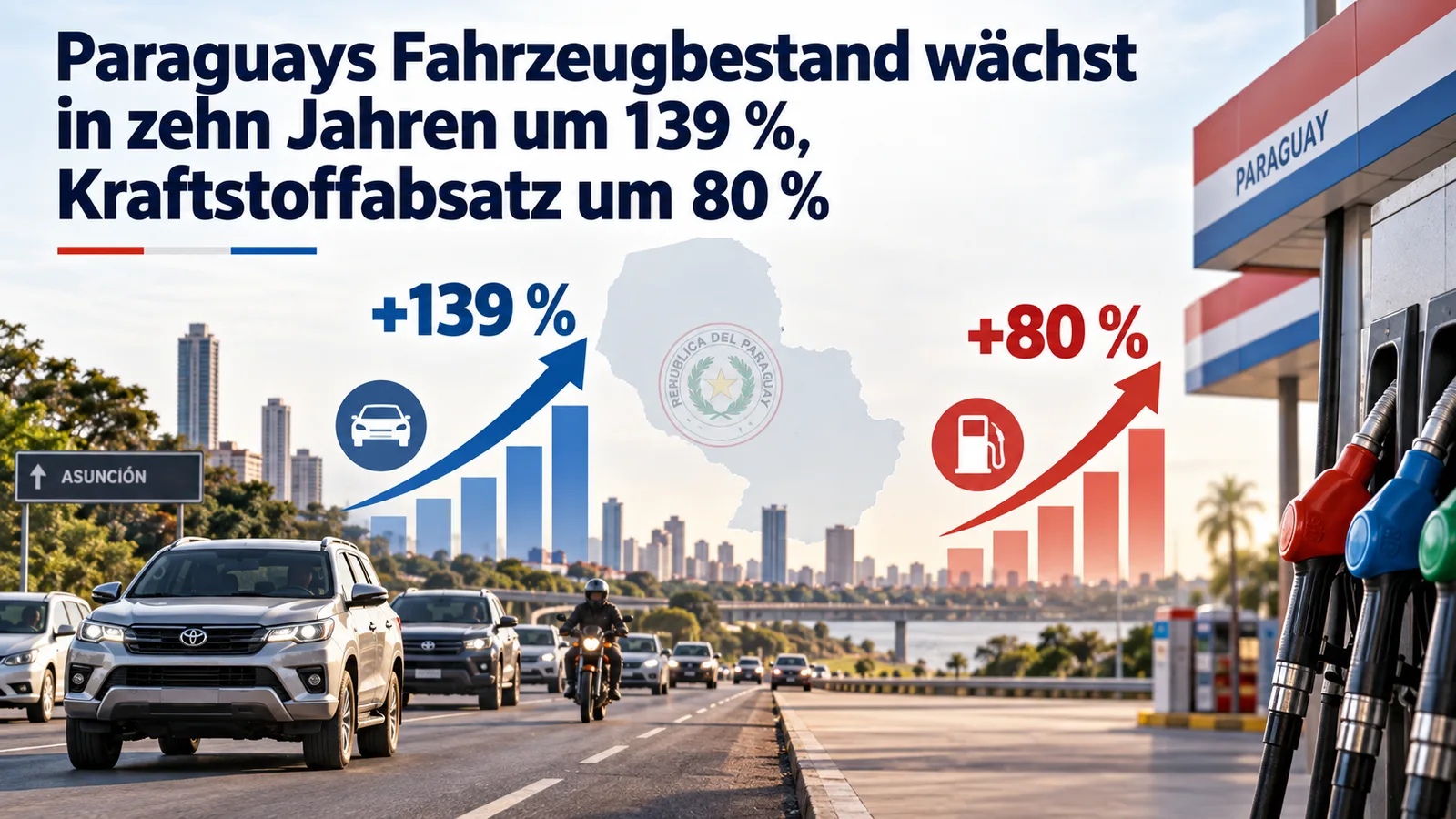
Paraguay’s vehicle fleet grew 139% between 2014 and 2025, while fuel sales increased 80% over the same period. Vice Minister of Commerce and Services Alberto Sborovsky presented the figures at Energías Paraguay 2026, according to Última Hora.
Sborovsky said the Ministry of Industry and Commerce (MIC) is the implementing authority for fuel and hydrocarbon policy through its General Directorate of Fuels. According to his presentation, the ministry regulates fuel marketing and sector practices but does not set retail prices.
The reported 113% diesel increase conflicts with BCP data
The report on Sborovsky’s presentation also said diesel prices had risen 113% so far in 2026. That figure conflicts with consumer-price data released the same day by the Banco Central del Paraguay (BCP), Paraguay’s central bank. The BCP consumer-price series, reported by Última Hora on the afternoon of October 2, shows common diesel up 33.0% year to date and additive diesel up 24.4%. Fuels as a group were up 22.8%.
The available publications do not explain whether the 113% figure used a different comparison basis, was reported incorrectly or was itself a mistaken figure. Pytagua therefore does not treat 113% as a verified increase in the retail price of diesel.
Biofuels are intended to reduce import dependence
Sborovsky said Paraguay imports all of its diesel and does not refine petroleum fuels domestically. He put Paraguay’s current biodiesel blend at 7%, compared with 15% in Brazil and 7.5% in Argentina. The government and private sector are expected to assess a possible increase to 8% from January.
For gasoline, the presentation put the ethanol blend at 30%, with a target of 32% by 2030. A recent rule requires 50% of the ethanol used in the blend to come from sugar cane, while the MIC retains authority to adjust that share in force-majeure situations to protect supply.
The industry figures come from the government presentation
Sborovsky estimated that the biofuel policy saves about USD 260 million a year in foreign exchange. He cited nine active ethanol plants and three biodiesel plants, more than 76,000 direct jobs across the value chain and 4.7 million tonnes of domestic raw materials processed in 2025. He also put ethanol exports at USD 80 million, biodiesel exports at USD 34 million and accumulated plant investment at more than USD 560 million.
Those figures are claims from the vice minister’s presentation rather than an independent audit of the entire sector. The same distinction applies to his recommendations for service stations to expand beyond fuel sales and consider purchasing pools or shared distribution centers to improve logistics.
The presentation’s broader picture — a rapidly expanded vehicle fleet, higher fuel volumes and a policy push toward biofuels — is not changed by the 113% discrepancy. The short-term price claim, however, should be read against the BCP data: the published year-to-date increase for common diesel is 33.0%, not 113%.